

Australia’s competitive position in electricity network equipment and infrastructure
Electricity networks are crucial for the clean energy transition and clean tech manufacturing opportunities. Shifting from a centralised fossil fuel system to a renewable system will require a larger and more sophisticated grid to:
- Connect new sources of supply. The best renewable resources are often located far from demand centres and current transmission networks (this is especially the case for Australia, with solar irradiance and wind speeds highest in regional and remote areas).
- Dealing with new grid stability issues. Demand and supply of electricity are becoming more variable and complex, including high penetration of rooftop solar, new sources of demand (e.g., heat pumps, EVs), and higher variability of electricity supply. This, in turn, creates grid issues related to load management and other areas such as inertia, system strength, and voltage control from new technologies.
AEMO estimates 10,000-35,000 kilometres of new grid infrastructure is required in Australia by 2050 (400-1,400km per annum) under the Step Change and ambitious Green Exports scenarios respectively. This is a ~40-400% increase in per annum additions compared to the past 5-year average. A large amount of distribution infrastructure and distributed energy resources (DER) integration and infrastructure will also be needed as the grid becomes more distributed.
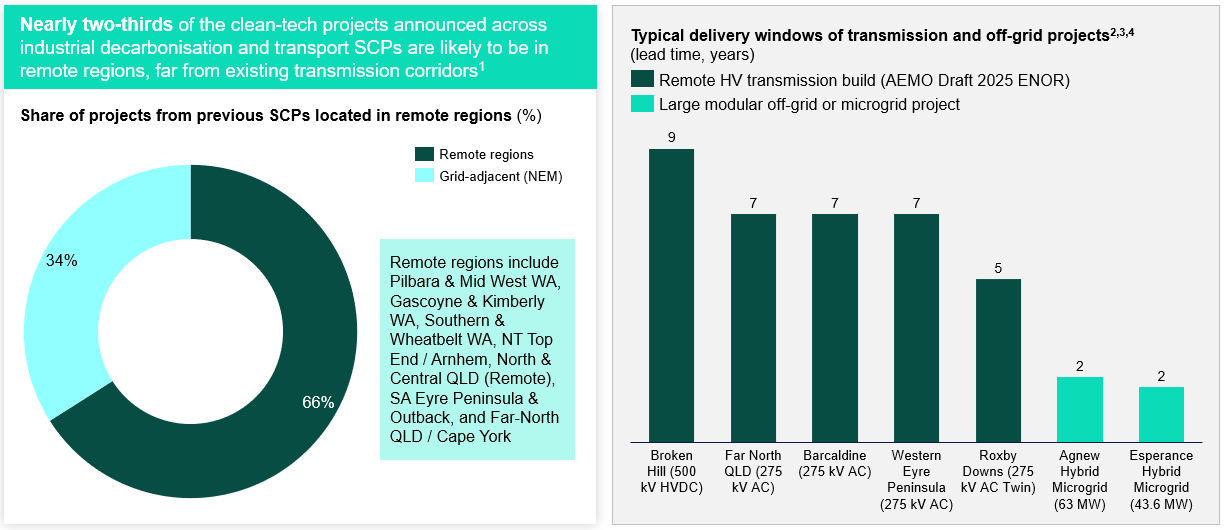
These network additions will be essential to capture the clean tech manufacturing opportunities identified in the Powering Australia Sector Competitiveness Plans, 66% of which are expected to be in remote locations without grid access. However, supply is struggling to keep pace, increasing prices and lead times which risks energy transition timelines and impacts the cost of living.
Equipment such as cables, conductors and transformers have seen cost increases of 44%, 32% and 25% respectively in Australia and these trends are being seen across global supply. Lead times have also increased, with some specific infrastructure such as power transformers and subsea HVDC cable, having slots booked until the late 2020s and 2030 respectively. This risks undermining the overall energy transition and clean tech manufacturing opportunity, creating delays and a more expensive transition. Higher network costs also increase cost of living concerns, with transmission and distribution costs typically accounting for 35-45% of what consumers pay for their electricity in most jurisdictions. It is imperative for Australia to ensure it has sufficient domestic access to critical T&D equipment.
Australia already manufactures equipment across the T&D value chain, contributing to over A$2 billion in GVA per annum. This is expected to increase to support growing demand. Based on historical growth over the past five years, this could grow to A$5 billion in GVA by 2035.
Australia could grow its presence in networks by focusing on three anchor opportunities:
- Custom solutions for off-grid and remote deployment
- Higher voltage transformers
- Distributed integration services
As for the first opportunity, custom solutions for off-grid and remote deployment, around two-thirds of the overall clean sector manufacturing opportunities identified in the Powering Australia analysis are dependent on off-grid solutions. From a networks perspective, this includes modular skids/substations, modular towers (e.g. monopoles), and standalone power systems.
This presents a large market opportunity for Australian businesses who specialise in custom off-grid solutions such a modular microgrids. The delivery timeline differential for these custom solutions is significant. Extending new 275kV+ lines to remote sites routinely takes 7-9 years once planning, heritage approvals, and construction are factored in. Modular microgrids, by contrast, can be factory‑fabricated, shipped, and energised in roughly two years, providing a practical schedule bridge for hydrogen hubs, mineral refineries, and First Nations communities while long-haul transmission upgrades proceed.
Furthermore, in certain cases using custom off-grid solutions may be lower cost than the alternative of long-distance high voltage line extension to the grid. Using AEMO’s Barcaldine-Lilyvale 275kV corridor (340km) as a proxy example indicates reconfiguring a traditional double-circuit line into a single-circuit intertie supported by regional microgrids reduces net-present cost by approximately one-third from A$2 billion to A$1.4 billion. Cost reductions derive from shorter conductor runs, fewer towers, smaller substations, and avoided outage penalties.
Exhibit 1: Remote project share and typical delivery timelines for high‑voltage transmission vs modular microgrids.[a]
There are multiple individual components considered within the custom off-grid solutions opportunity. Australia’s competitiveness lies in provision of the overall solution, however that doesn’t necessitate each individual component being manufactured here.
Australia’s harsh operating envelope, cyclones, searing heat, red‑dust and bushfire risk has resulted in local firms engineering power hardware that is both modular and climate‑resilient. That experience now positions Australia to build a sovereign supply chain around three exportable niches:
- Modular tower designs (e.g. monopoles): traditional tower designs under‑perform in Category D wind zones, while modular designs can use fewer parts, need smaller pads, and can be craned in quickly. Existing wind‑tower rolling lines already meet cyclone and salt‑spray standards. Stakeholder consultation suggests that co‑locating tower fabrication with wind tower lines can smooth throughput and lower fixed costs.
- Modular substations / skids: mines and hydrogen hubs have bred a domestic ecosystem that certifies sealed GIS/AIS skids for heat, dust, and vibration. Units arrive fully wired, slashing mobilisation time. For example, Ampcontrol delivers factory‑tested, flame-proof skids that drop to site and connect within hours.
- Stand-alone power systems / microgrids: Australia excels at rugged enclosures, heat‑tolerant control software, and rapid‑deploy frames, but the battery‑inverter‑genset stack is a global commodity. The efficient path is to integrate imported electronics while focusing locally on anchoring, climate sealing, and long‑term O&M. Joint ventures that combine global power electronics majors with Australian enclosure and service specialists.
In terms of Transformers, Australia already has a strong presence in lower voltage transformers, producing a competitive, quality and fit-for-purpose product. Extending to the next set of voltage classes is achievable with similar cost structures and a strong demand profile coming from the expanding grid plus private off-grid requirements, along with international interest from countries using the same specifications. Domestic manufacturing can lower the high lead times and supply-chain bottlenecks currently being experienced.
Domestic manufacturers in Wilsons, Tyree, and Ampcontrol primarily produce power transformer products up to the 132kV primary voltage class (Wilsons have manufactured up to 400kV but there have been historically low levels of production here compared to global facility scales). Domestic manufacturers have exported to international markets such as New Zealand, the South Pacific, and the U.K., demonstrating Australia’s ability to export competitively to overseas.
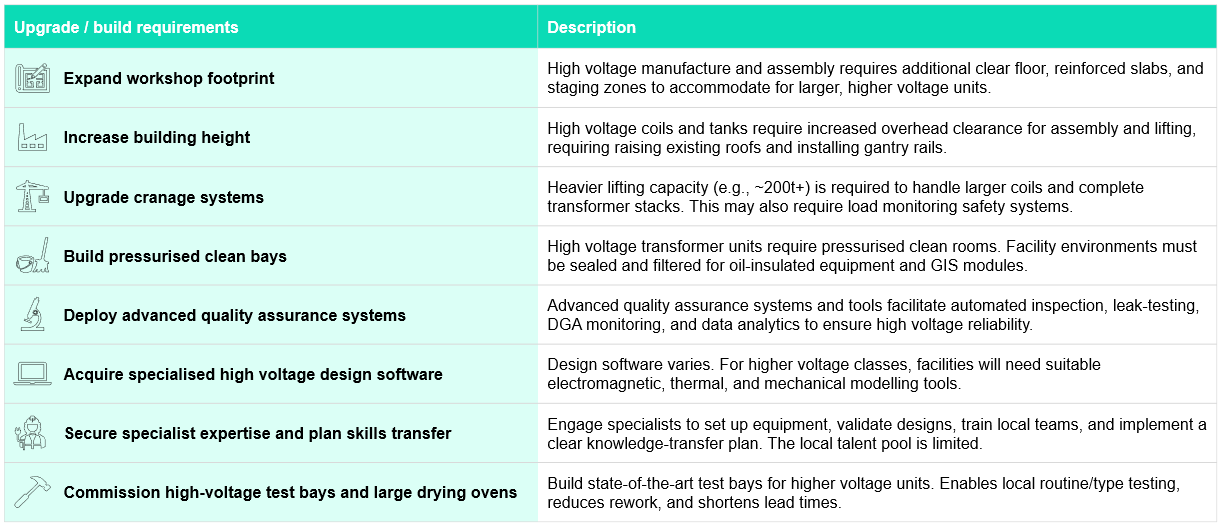
Consultation suggests that there are 8 key requirements to step up Australia’s capability to higher voltage classes:
Exhibit 2: Requirements to step Australia’s domestic transformer manufacturing industry to higher voltage classes
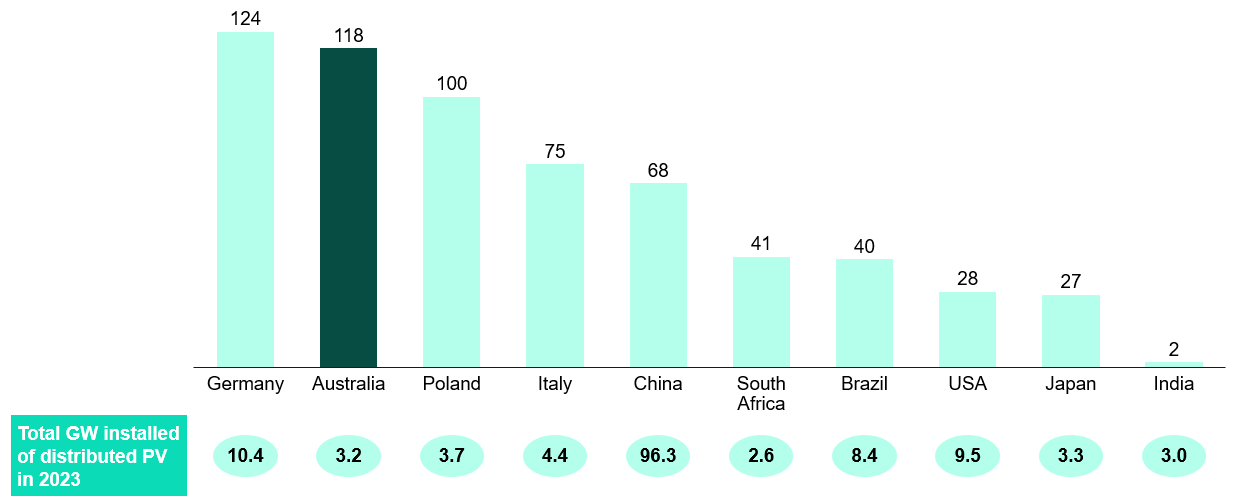
Finally, on Distributed integration services, while not a physical manufacturing opportunity, DER integration services were identified as an additional enabling opportunity where Australia has a strong advantage. Australia’s world leading rooftop solar deployment has led to it facing challenges and developing solutions in DER integration earlier than many global peers. This is leading to a strong service-based capability which could be traded on globally. These services are centred around integrating and orchestrating Distributed Energy Resources (DER) (including rooftop solar, batteries, EV & V2G). Both software and hardware are required to support this integration and orchestration including use of dynamic operating envelopes, enhanced visibility and monitoring and sensors and automation.
Exhibit 3: Australia ranks alongside Germany as a global leader in distributed PV per capita
Several challenges and service opportunities are already arising as DER penetration increases
Table 1. Emerging service opportunities to address challenges from high DER penetration
| Challenges of high DER penetration | New service opportunities dealing with challenge | Description | Potential buyers |
| Integrating into dispatchable markets | VPP aggregation and community battery services for FCAS and energy | Service providers can aggregate small batteries, PV and controllable loads to bid FCAS and energy and capture value through price arbitrage
Community batteries can also be aggregated and used for local peak management and shared arbitrage |
Retailers, aggregators, C&I fleets. |
| Flexible trading enablement | Service-providers can stand up secondary settlement points and metering data flows so individual devices can be priced and settled separately from the main connection point. | Retailers, energy service firms, fleet owners | |
| Reverse power flows and feeder constraints | Dynamic export orchestration using DOEs | Service-providers can calculate and send dynamic per-site export/limits to keep LV feeders within thermal and voltage limits while maximising customer exports. | DNSPs, retailers |
| Interoperability and secure device control | Gateway and fleet control services | Service-providers can provide CSIP-AUS compliant gateways and cloud control services supporting the ability for more DERs to be orchestrated despite a diverse environment of OEMs (e.g., different solar providers, electric vehicles etc.). | DNSPs, OEMs, VPPs |
| Lack of low-voltage visibility and hosting capacity | Low voltage network analytics and hosting capacity services | Deploy LV monitors and analytics to model voltages, estimate headroom and publish hosting capacity maps and DOEs. | DNSPs |
Service providers offering these new solutions will leverage innovative software and hardware that can orchestrate across DERs, provide grid visibility and traceability and utilise automation and smart grid/Internet of Things (IoT) enablers such as sensors.
Australia has among the most advanced FCAS markets in the world, including early adoption of Very Fast FCAS in 2023 and the world’s first grid-scale battery providing inertia and FCAS through the Hornsdale project. These advances position Australia’s service providers and solutions as globally competitive and exportable.
In addition, Australian solutions are often developed to deal with extreme heat and weather events, vast and remote grids, and constrained transmission capacity. As a result, local solutions are designed to actively manage voltage and thermal limits, improve situational awareness, and reduce the cost and time to connect new generation in challenging environments which can be traded on as a differentiated factor increasing the competitiveness of our services.
Table 2 provides a list of example service providers already working in the field:
Table 2. Australian DER integration service examples
| Service category | Description | Example Australian capability |
| DER orchestration & flexibility | Software platforms that aggregate and actively control distributed energy resources (e.g., rooftop PV, batteries, EV/V2G) and apply dynamic line-rating to maximise flexibility and limit congestion. Includes “transmission as a service” models where grid-scale batteries provide contractable transmission capability (e.g., SIPS/virtual/synthetic transmission). |
|
| Grid data, visibility, & traceability | Cloud-based tools for real-time monitoring, traceability, and scenario modelling across network assets and projected flows |
|
| Sensors, automation & robotics | Hardware and robotics solutions, including sensors, drones and field robots, that inspect, construct, and maintain remote or harsh-environment networks |
|
| System standards & interoperability | National inverter and comms standards (AS/NZS 4777.2) underpin secure DER integration at scale |
|
In summary, expanding and modernising Australia’s electricity networks is essential both to deliver the clean energy transition and to unlock domestic clean tech manufacturing, particularly in remote areas. There are three opportunities where Australia can build competitive advantage: custom off-grid and remote deployment solutions, higher-voltage transformer manufacturing, and distributed energy resource integration services. Together, these opportunities would help strengthen energy security, reduce transition bottlenecks, and position Australian firms to capture greater value from rising domestic and global demand.
Footnotes:
[a] 1. See appendix for full list. 2. AEMO (2025). 3. Construction for Agnew commenced 2018 and entered commissioning mid-2020. Mine Digital (2023). 4. Construction for Esperance commenced in September 2020 and entered commission in the first quarter of 2022. Horizon Power (2020), Horizon Power (2022).
[b] SwitchDin (n.d.)
[c] Infrastructure Partnerships Australia (2024), PlusES (n.d.)