

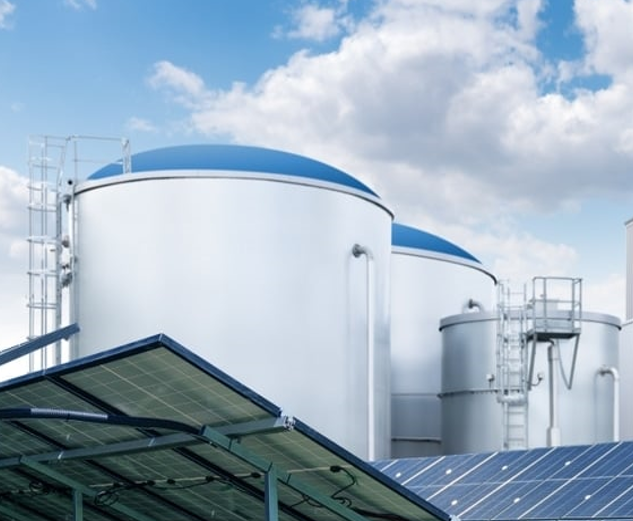
Industrial decarbonisation presents a sizeable opportunity for Australia to manufacture clean technology products in an emerging market with few established incumbents. Australia has, and contributes to, several emissions-intensive industrial activities such as steel production, cement, fertiliser, and more. Industrial activities account for 34% of Australia’s total emissions, but this substantially understates our exposure. In 2024, Australia exported 866 million tonnes of iron ore. The total Scope 1 to 3 emissions from this industry alone is 227% of Australia’s domestic emissions.
Many industrial decarbonisation opportunities, especially the products, are still nascent. This is due to technology maturity, high capital requirements and high-cost sensitivity in the sector. There is considerable ‘’white space’’ for Australia. Whilst industrial decarbonisation only accounted for ~5% of clean technology investment in 2024, under a net-zero trajectory, this could grow to over 40% by 2050, representing trillions of dollars of investment. Further, there are few to no incumbents in many of the largest opportunities.
Cyan Ventures looked at 33 discrete clean technologies required for industrial decarbonisation including both clean industry products (e.g. green metals, green hydrogen) and equipment (e.g. industrial heat pumps, electrolysers) to understand where Australia is most likely to be competitive.
The three strongest opportunities for Australia in Industrial Decarbonisation are:
- Green ammonia: Ammonia produced with green hydrogen feedstocks and renewable electricity. Competitive in Australia due to abundant renewable energy resources and potential for low-lost renewable electricity.
- Green iron: Iron produced with near zero emissions, such as through the use of green hydrogen as a reductant or electrolysis. Competitive in Australia due to abundant renewable energy resources, potential for low-cost renewable electricity and large domestic reserves of iron ore feedstocks.
- Green aluminium: Aluminium produced with near zero emissions through renewable electricity use in the smelting process and green alumina used as feedstock (produced through near zero-emission alumina refining). Competitive in Australia due to abundant renewable energy resources, potential for low-cost renewable electricity and large bauxite feedstocks.
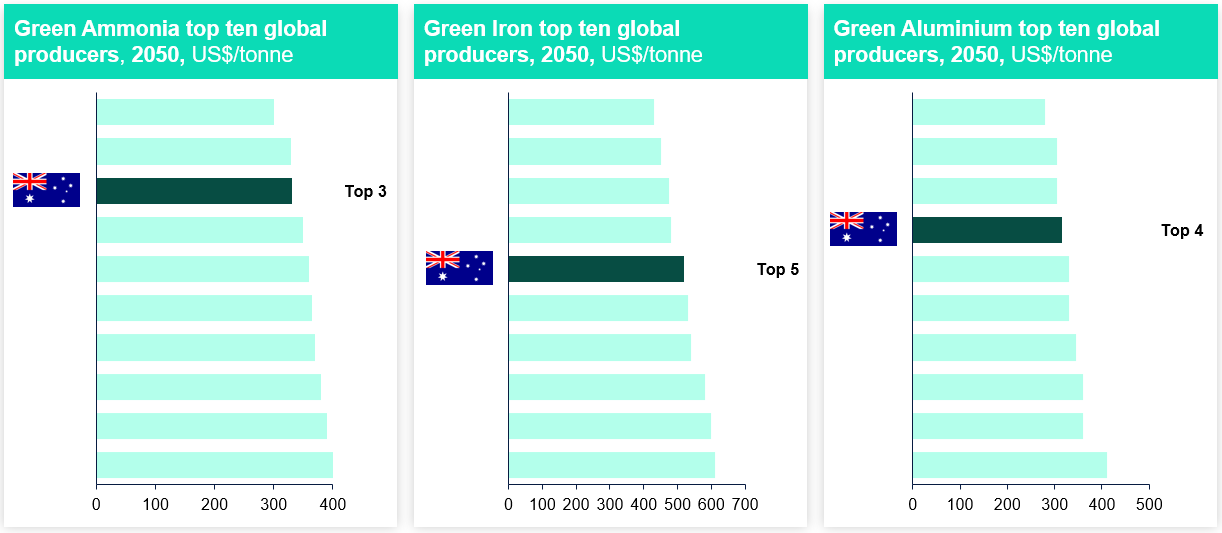
These anchor opportunities represent a major strategic opportunity for Australia and could add A$31 billion to the economy by 2035. By 2050, Australia could be within the top 5 lowest cost geographies for producing these anchor opportunities.
Exhibit 1: Potential future production cost competitiveness across anchor opportunities in green markets (US$/tonne).[a]
Targeted strategies are needed to develop the green markets Australia can lead in.
Grey pathways (i.e. conventionally fuelled) are much cheaper than green across the three anchor opportunities. The pursuit of green-only pathways, the green cost gap, and lack of a green-premium, has resulted in green projects struggling to reach final investment decision (FID).
There are three main ways to progress these opportunities:
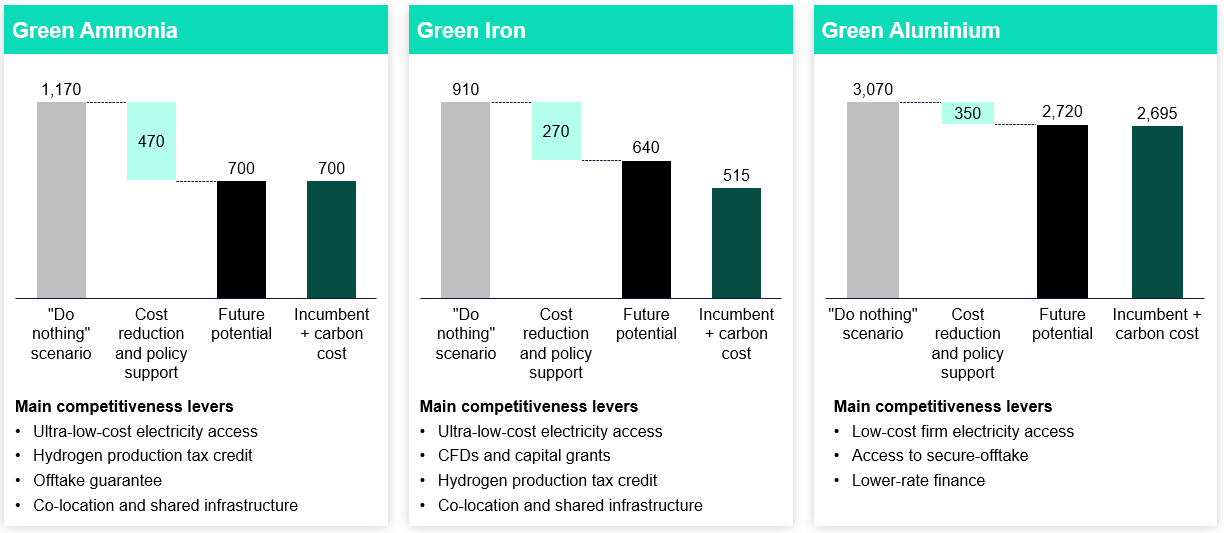
1. Close the production cost gap between green products and their alternative: Australia has the potential to be a cost leader in the green production, but green production costs still need to be reduced to reduce the gap to grey/incumbent costs. Our modelling shows that by 2035 costs could be reduced for green ammonia by 40%, green iron by 30% and green aluminium by 11% through getting to renewable LCOE cost reductions targets, the implementation of planned policies (e.g. the H2 production tax credit), and efficiency gains through co-location and shared infrastructure.
Exhibit 2: Expected 2035 production costs and possible cost reductions (LCOP US$/tonne)
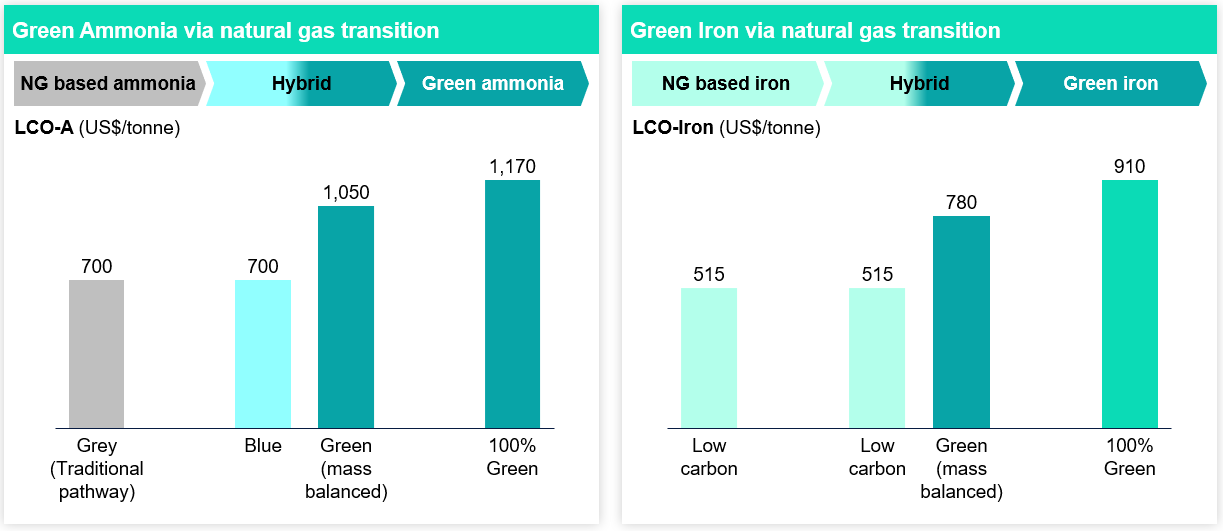
2. Lower barriers by implementing transition pathways: Intermediate pathways such as green mass-balanced plants beginning with natural-gas based hydrogen and blending green hydrogen in over-time can overcome high upfront barriers.
Cost models show this strategy may lead to more viable projects. This may allow Australia to develop a foothold in the industry and then switch over to full green production as technologies are de-risked and costs reduce. Plants must be developed so they can transition to green production over-time.
Exhibit 3: Potential costs of intermediate transition pathways (LCOP US$/tonne)
3. Target buyers who want, or can bear the cost of, green products: Some markets are willing and able to pay for green products, such as Japan. In other markets, a premium product has little overall cost impact.
For example, green explosives used in Australia’s mining sector would only add ~0.4% to overall operational costs. Green iron and steel could focus on higher-value segments like premium automotive (increase in costs is only ~2%). Similarly, green aluminium is best positioned for early uptake in high-value consumer markets such as automotive (~1% increase in costs) and consumer electronics (~1.5% increase in costs), where end consumers value, and are willing to pay for, the higher quality product.
Exhibit 4: Strategies to develop Industrial Decarbonisation Anchor opportunities
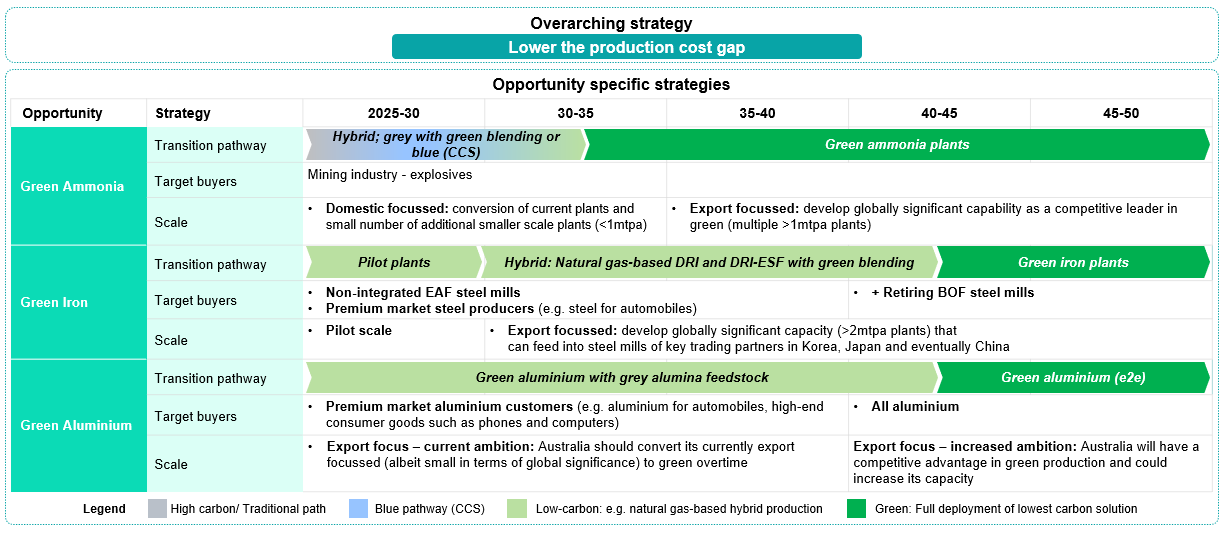
In summary, Australia has a significant opportunity to lead in industrial decarbonisation by building competitive positions in green ammonia, green iron and green aluminium, supported by abundant renewable resources and feedstocks. Realising this opportunity will require reducing the cost gap with conventional production, enabling practical transition pathways, and focussing on early markets that can absorb a green premium, steps that could unlock major economic value and position Australia among the world’s lowest-cost producers over time.
Footnotes:
[a] Ammonia: Mission Possible Partnership (2022) – Assumes lowest cost green ammonia production pathway in 2050 as dedicated VREs plus geological H2 storage. Iron: RMI (2024). Aluminium: Mission Possible Partnership (2023). Assumes lowest cost green alumina production pathway in 2050 as H2 boiler plus H2 calciner.