

About this episode
Most governments that want a clean fuels industry start with a mandate. A mandate tells fuel suppliers they must buy. It does not tell a developer what price they will get over the life of a loan. Without that, it is hard to raise the debt for a first plant.
The UK has legislated a revenue certainty mechanism, and European governments are piloting double-sided auctions. Mahesh explains how these work and what the UK has learned so far. Mahesh also covers the other risks that stop projects reaching a final investment decision, and what Australia could do as it designs its own policy.
About the guest
Mahesh Roy is Executive Director, Clean Industry at the Green Finance Institute in London. He leads GFI’s sustainable aviation fuel programme.
Mahesh also oversees GFI’s work on carbon dioxide removal, and on clean power finance in emerging markets with the World Bank.
Before GFI, Mahesh was a Director at IIGCC and CDP, after nearly two decades in banking and finance, mainly with Macquarie. Mahesh is Australian, started out in banking in Sydney, and holds an MBA in Energy from Cranfield University.
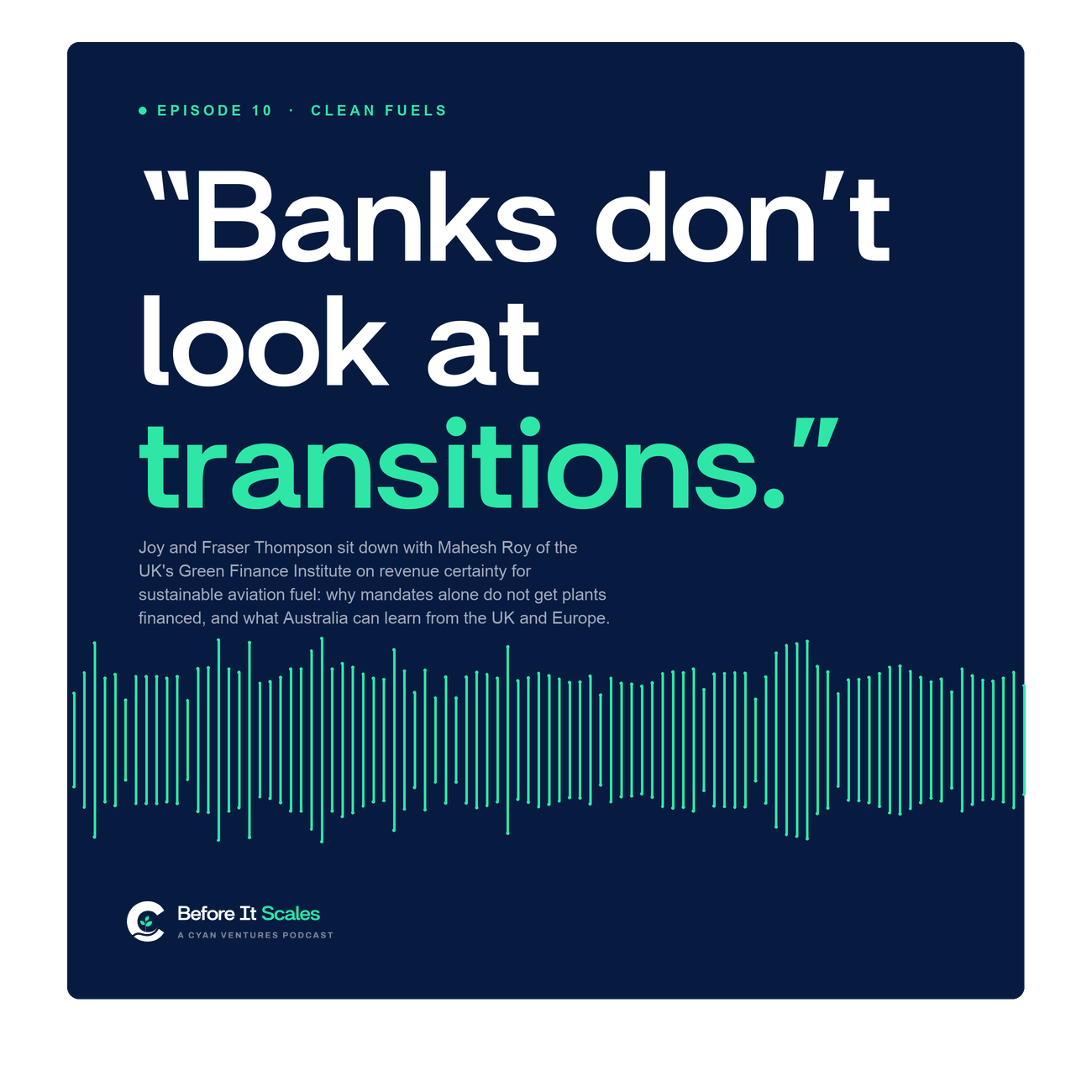
”Banks don't look at transitions. You don't lend against the transition, you lend against the transaction."
Mahesh Roy
Key Links
- Watch the video
- Green Finance Institute
- Mahesh Roy on LinkedIn
- No Silver Bullets (GFI)
- From green premium to security premium (GFI)
- Bank guarantees for e-SAF double-sided auctions (GFI)
- Demand Isn’t Enough: Why Australia Needs Revenue Certainty to Unlock Low Carbon Fuels
- Cyan Ventures Newsletter (or subscribe below)
- Cyan Ventures LinkedIn
We cover
- Mahesh’s path from a bank call centre in Sydney to green finance in London
- Why a SAF plant is harder to finance than a wind farm
- Why banks lend against transactions, not transitions
- Why airlines will not sign 15-year offtake contracts at today’s prices
- How contracts for difference and double-sided auctions work
- Where the UK’s revenue certainty mechanism is up to, and the floor price problem
- Policy risk and the protection of private law contracts
- Construction risk, CO2 supply and de-risking the whole value chain
- Development capital, and why government should place bigger bets
- What Australia could do: when a production credit fits, and when revenue certainty is needed