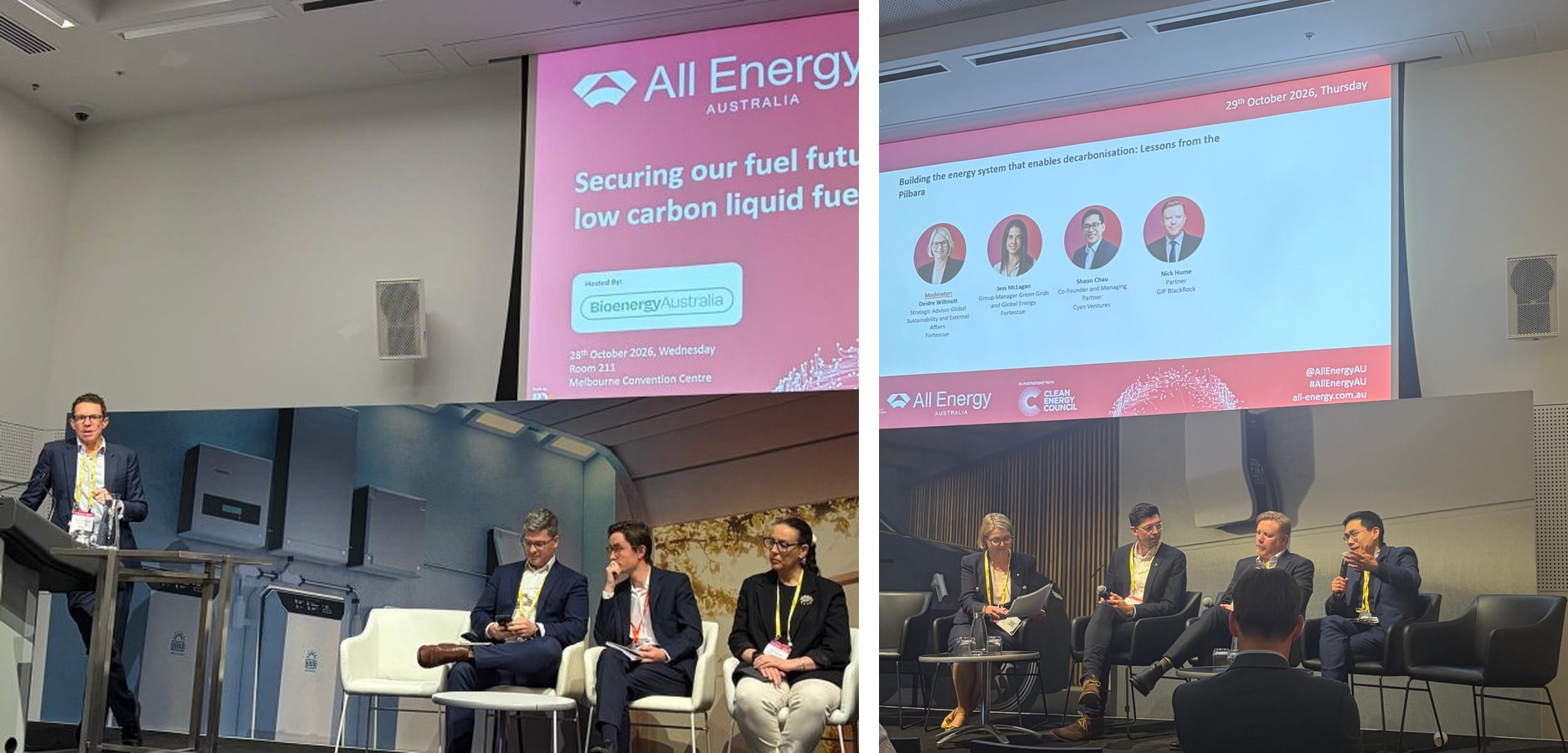
Australia is not short of clean energy projects, technology or ambition. What it is short of is the social, political and financial plumbing to get them built. That was our main takeaway from All-Energy Australia, held at the Melbourne Convention and Exhibition Centre on 28–29 October.
Cyan Ventures had a busy three days. The day before the conference, we worked with Mission Possible Partnership (MPP) to run the Build Clean Now workshop on green industry with around 50 experts including project developers, offtakers, investors and government officials. During All Energy, Fraser Thompson moderated the session on low carbon liquid fuels (with representatives from airlines, maritime and heavy transport), and Shaun Chau joined the panel on decarbonising the Pilbara. Across those rooms and the corridors in between, six issues kept coming up.
1. Cost of living is making policymakers cautious, even on cheap reforms
Every energy decision is now judged through a household-budget lens. In September, 65% of Australians named cost of living as a top-three national issue in the Ipsos Issues Monitor; just 9% named the environment. The 2026 fuel price shock has only sharpened that focus.
Exhibit 1: Cost of living has pulled far ahead of the environment as a national concern
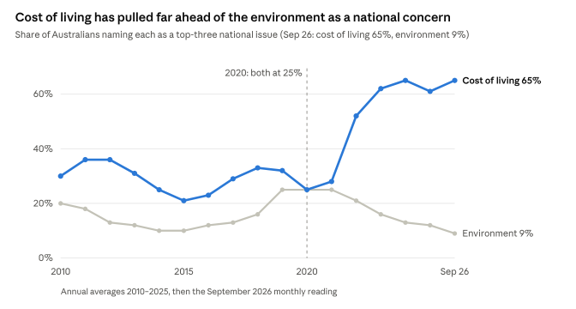
Source: Ipsos Issues Monitor, September 2026 (about 1,000 adults a month pick their top three of 19 issues)
The result is caution in Canberra, even where reform is cheap. The clearest example, discussed in our low carbon fuels session, is the demand mechanism for low carbon liquid fuels (LCLF). The Government committed to it in the 2026–27 Budget and consulted on a design until 15 September. There is a real risk it is delayed or diluted in the name of affordability.
That would be a false economy. Cyan Ventures’ modelling found a 5% sustainable aviation fuel blend by 2030 would add less than a cup of coffee to most domestic fares, and around A$7.40 to a Sydney–Singapore ticket. Credit banking and a capped penalty can keep compliance costs in check. With fuel security front of mind, a domestic fuels industry is a cost-of-living answer, and the sector needs to make the case in those terms.
2. Licence to operate is becoming the binding constraint
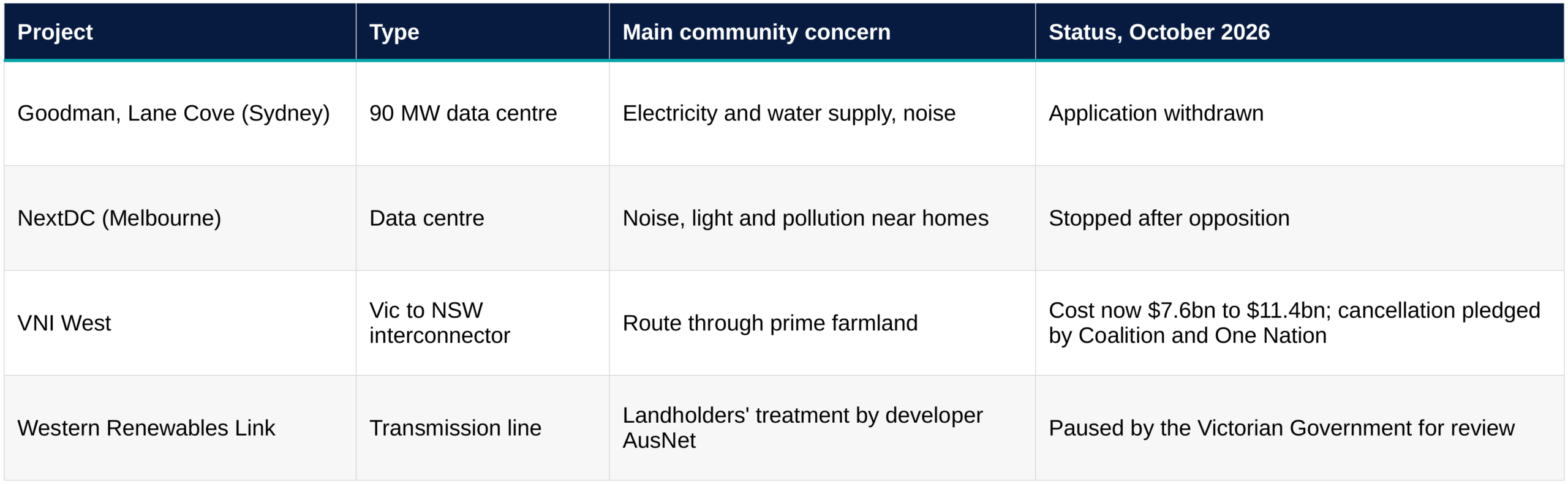
More projects are now stopped by communities than by technology or capital. In the past two months, data centre proposals from Goodman and NextDC in Sydney and Melbourne have been halted after resident opposition, while major transmission lines in regional Victoria are stalled by landholder resistance (Exhibit 2).
Exhibit 2: Recent projects stalled by community opposition
The US answer to data centre backlash has been “clean compute zones”. Australia can go further. Off-grid or behind-the-meter data centres, sited away from suburbs with their own renewables and storage, can be the anchor customer that underwrites a wider green industry zone. Their firm, creditworthy demand helps finance shared generation, water and transmission that green metals, fuels and chemicals plants can then use. That turns a contested load into a regional jobs story, which is what licence to operate ultimately rests on.
3. Political risk is back, starting with Victoria
Notwithstanding many other important issues, the Victorian election on 28 November has become (in part) a referendum on transmission. The Coalition and One Nation have both pledged to cancel VNI West, and both have flagged reviewing or scrapping the Western Renewables Link, while Labor says it will build VNI West (Exhibit 3). This comes less than two years before EnergyAustralia’s Yallourn plant exits, removing 1,482 MW, around a fifth of Victoria’s power use.
Exhibit 3: Party positions on key Victorian energy issues
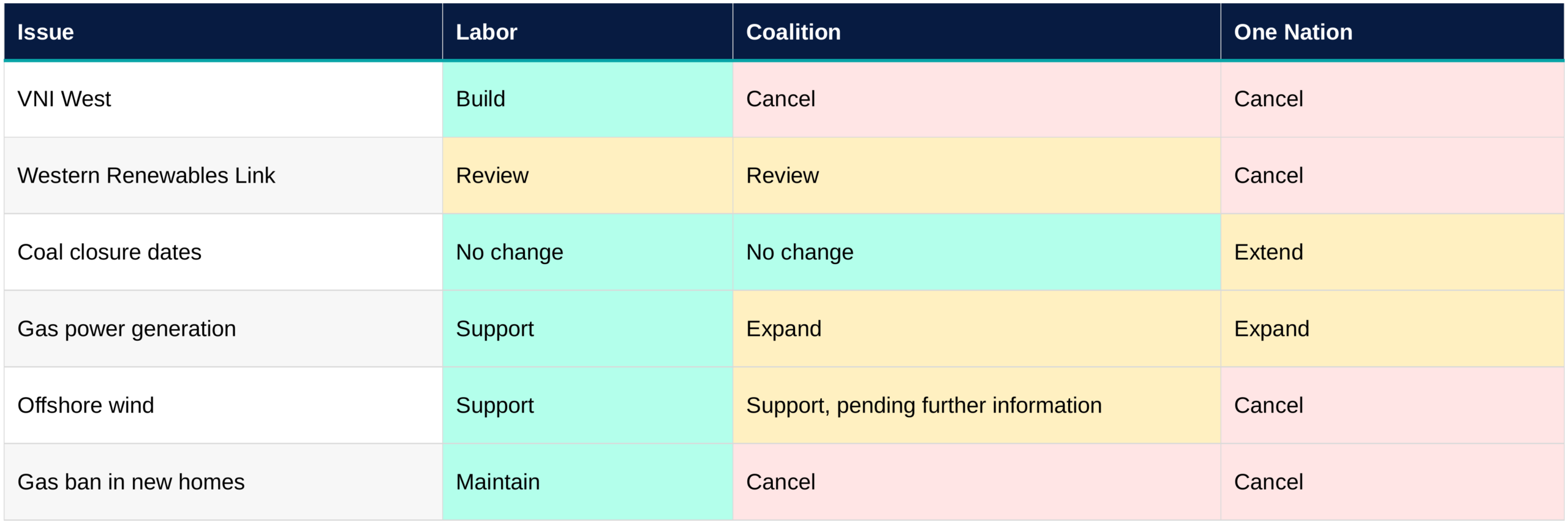
Source: Australian Financial Review, 30 October 2026.
The merits are genuinely contested. Supporters argue VNI West is needed to move renewable power around the grid during wind and sun droughts. Sceptics such as economist Bruce Mountain argue it does not stack up against cheaper options, including solar and batteries on factory rooftops. Either way, as the Grattan Institute’s Tony Wood points out, every reversal in core assumptions gets priced into risk premiums and ends up in bills.
Our view is that the sector should stop treating this as a binary. Industrial estates hold large untapped rooftop and land area close to load. Quantifying how much urban renewable parks can genuinely reduce the need for new transmission gives any incoming government a practical, lower-conflict option, and gives developers a durable plan to invest against.
4. Inequality: renters are being left out of the energy transition
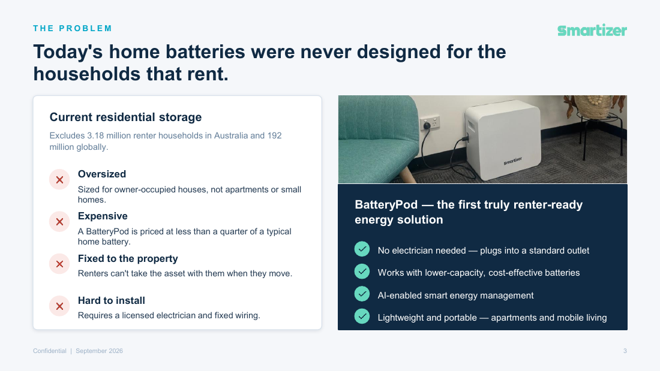
Around 31% of Australian households rent, roughly 3.18 million homes. Most are locked out of rooftop solar and home batteries because the systems are sized for owner-occupied houses, need an electrician and stay with the property (Exhibit 4). That means renters miss out on bill savings and rebates that homeowners capture, and a two-tier transition is a fast way to lose public support.
The policy door is starting to open. In September, federal and state energy ministers agreed to explore pathways for the safe deployment of plug-in solar and batteries. Industry advocates are pushing for them to be legal by 1 July 2027, although that is not yet a government commitment. The opportunity is for Australian companies to be ready on day one. Cyan Ventures has been supporting one innovative Australian startup in this area – Smartizer, whose plug-in BatteryPod is built for renters. See our interview with Smartizer’s founder, Davood Dehestani.
Exhibit 4: Why today’s home batteries don’t work for renters
Source: Smartizer
5. Funding: green industry is stuck in the missing middle
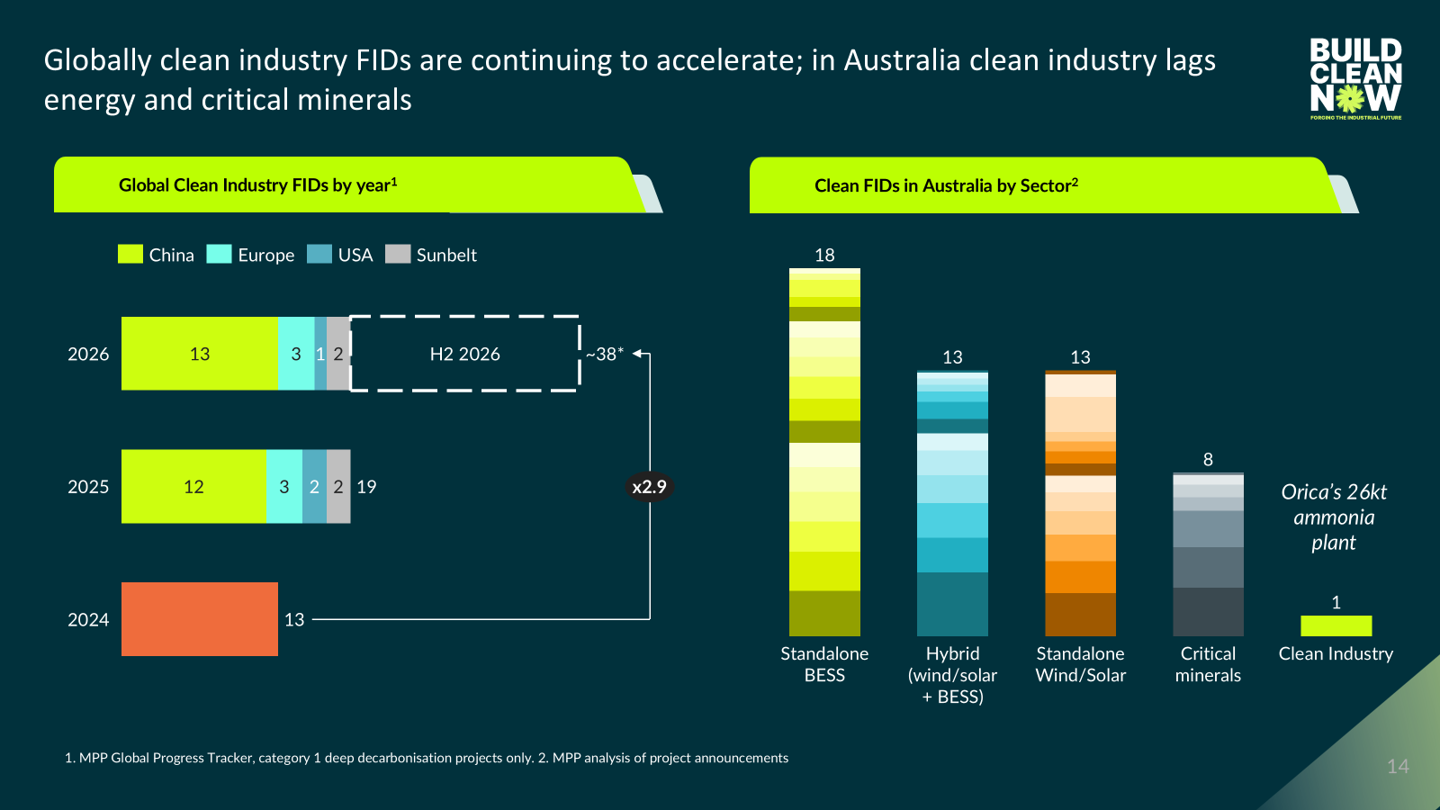
Australia has one of the world’s largest clean industry pipelines, with around 70 projects in development. Yet the Clean Deal Monitor (produced by Mission Possible Partnership and Cyan Ventures) shows that while energy and critical minerals projects are reaching final investment decision (FID), clean industry has managed just one: Orica’s 26 kt ammonia plant (Exhibit 5). Globally, clean industry FIDs are on track to roughly double in 2026.
Exhibit 5. Clean industry lags energy and critical minerals at FID
Source: Build Clean Now; MPP Global Progress Tracker and MPP analysis of project announcements.
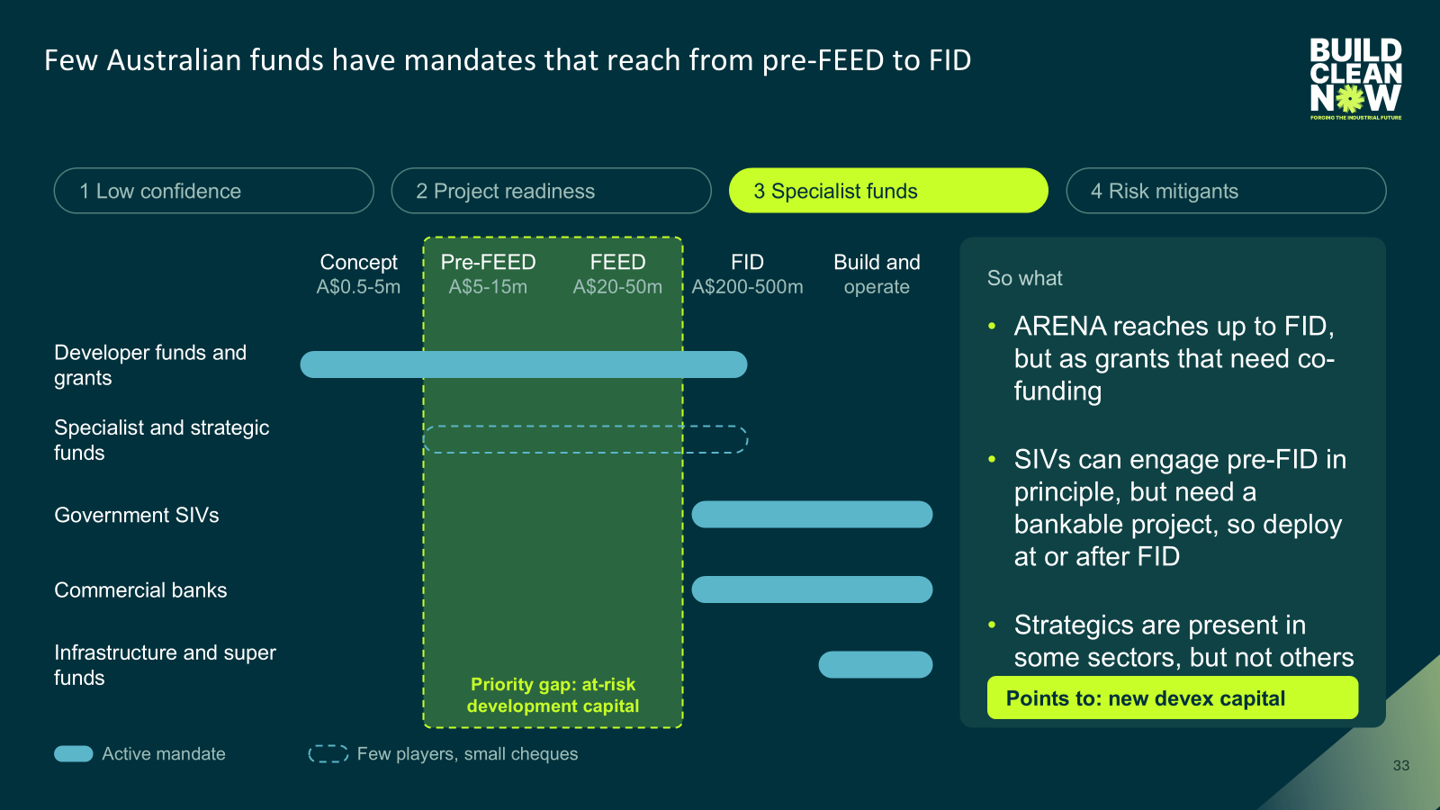
The bottleneck is not ideas or late-stage capital. It is the A$5–15m for pre-FEED and A$20–50m for FEED, where risk is highest and almost nobody’s mandate reaches (Exhibit 6). ARENA can fund up to FID, but its grants need co-funding. Government specialist investment vehicles and banks need a bankable project, so they deploy at or after FID. Specialist and strategic funds are few, with small cheques.
Exhibit 6. Few Australian funds have mandates that reach from pre-FEED to FID
Source: Build Clean Now.
Closing that gap needs new approaches. One option discussed at the Build Clean Now workshop is a government-led development capital fund that can take on pre-FEED and FEED risk without demanding matched co-funding. Structured as recoverable or convertible funding, it could be repaid at FID so the public shares in the upside of the projects that succeed.
6. Accountability: the plan keeps shrinking and nobody owns delivery
Australia has a plan for the electricity system it needs to build. What it lacks is clear accountability for delivering that plan. Responsibility is divided across market bodies, governments, network providers and investors, with no single organisation answerable for whether the system is built on time and at an acceptable cost.
AEMO published the 2026 Integrated System Plan in June. Its optimal development path identifies around 6,000 km of new transmission by 2050, adding to Australia’s existing 44,000 km network, alongside approximately $106 billion in capital investment. The transmission build is 1,435 km smaller than in the 2024 ISP, including around 1,680 km of transmission AEMO now considers unnecessary.
A smaller transmission build is not necessarily a problem. The more important question is whether the investment that remains can be delivered.
The generation pipeline already illustrates the challenge. AEMO identifies a need for approximately 18 GW of new wind capacity by 2030, but only around 9 GW is visible in the connections pipeline. Even if every wind and solar project currently in that pipeline is delivered on time, it would meet only around three-quarters of the new capacity required by 2030 (Exhibit 7).
Exhibit 7. The 2026 ISP identifies a smaller transmission build, but the generation pipeline remains short of what is needed

Source: AEMO, 2026 Integrated System Plan, June 2026, pp. 6, 12, 15, 18 and 24.
The ISP identifies what needs to be built, but it does not ensure that investment happens. AEMO explicitly states that the ISP “does not amount to a recommendation of any investment”. Decisions about what to build, where and when remain with investors, network providers and governments.
That distinction matters. AEMO can identify the investment required, but it cannot compel delivery. Regulatory bodies oversee different parts of the process, while Commonwealth and state governments make separate policy, planning and funding decisions. When projects are delayed, responsibility is spread across institutions rather than resting with a single organisation accountable for the overall outcome.
The consequences extend beyond missed milestones. Delays can undermine investor confidence, disrupt the sequencing of generation and transmission investment, and increase the cost of maintaining a reliable electricity system. Without clear accountability, it is difficult to determine who should intervene when delivery falls behind or who is responsible for bringing the plan back on track.
There is an opportunity to address this. The AEMC is currently reviewing the ISP framework, including its governance arrangements and the mechanisms that translate planning into investment. A draft report is due in December 2026, with the review scheduled for completion by 1 July 2027.
The sector should use this review to establish a clearer link between planning and delivery. That means setting achievable milestones, testing whether the costs remain acceptable to consumers, and assigning explicit responsibility for monitoring delivery and responding when projects fall behind. Any organisation given that responsibility must also have the authority to coordinate action across the institutions involved.
The common thread
None of these six issues is about technology. Each is about whether the transition is seen as affordable, fair and well run, and whether capital can follow. The projects that win from here will be the ones designed around households’ budgets, communities’ consent and investors’ real risk appetite from the outset.