

This analysis shares the work of Cyan Ventures examining how a revenue certainty mechanism could support the development of low carbon fuels in Australia, and act as a complementary tool to the current proposed demand mechanism. We wish to express our gratitude to Boundless Earth, a leading philanthropy which aims to accelerate climate solutions at the scale and speed required for Australia to do its fair share to avert the climate crisis, who funded this work.
Findings at a glance:
- A revenue certainty mechanism (RCM) is a government contract that guarantees a producer a fixed revenue per unit of output.
- Mandated volumes (linked to a demand mechanism) on their own have struggled to enable projects to reach financial close, and this gap is what a revenue certainty mechanism (RCM) is designed to close.
- The demand mechanism and the revenue certainty mechanism solve different problems. The demand mechanism removes volume risk by obliging fuel suppliers to buy; the revenue certainty mechanism can remove price and potentially some counterparty risk by fixing what the producer receives per litre. It can also help address the policy risk of future changes to the LCLF demand side mechanism (by transferring a significant portion of the revenue impact of policy change away from the project and onto the RCM counterparty).
- A well-designed RCM could significantly lower production costs (by 12-23%) through lower financing costs; in turn it could lower flight ticket costs by around 16%; and create significant fiscal benefits to the Australian Treasury of A$3-7 billion in net present value terms from 2027 to 2049.
The importance of offtake: why a demand mechanism is necessary but not sufficient.
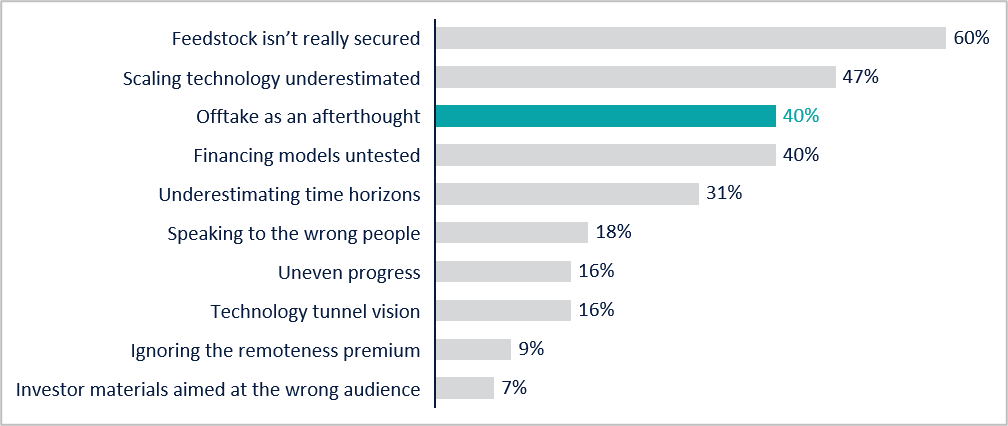
The Australian Government has recently launched consultations on a low carbon fuel demand mechanism.[1] A Low Carbon Fuel Demand Mechanism (LCFDM) is a policy that creates guaranteed or mandated demand for low-carbon fuels by requiring fuel suppliers, airlines, shipping companies or other obligated parties to progressively reduce the carbon intensity of the fuels they supply or use. This is a crucial step: polling at a recent Green Fuels Accelerator webinar revealed that the industry sees offtake as one of the main barriers holding Australia’s pipeline of low carbon liquid fuel (LCLF) projects back from financial close (Figure 1).
Figure 1: Top three challenges for LCLF projects, share of respondents selecting each. Poll of 45 respondents, consisting of project developers, investors, government officials and experts, Green Fuels Accelerator workshop, 27 August 2026
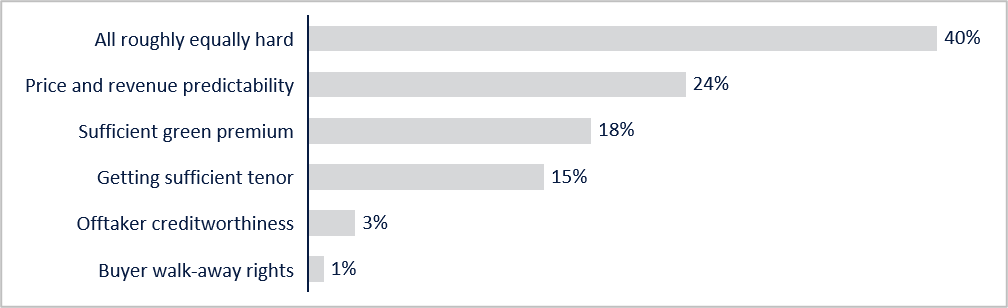
Offtake is not only about securing volumes. Other issues such as price volatility, contract tenor and offtaker creditworthiness are also seen as key barriers (Figure 2).
Figure 2: Which bankability gate is the biggest obstacle in the market today, share of 68 respondents, Green Fuels Accelerator workshop, 20 August 2026
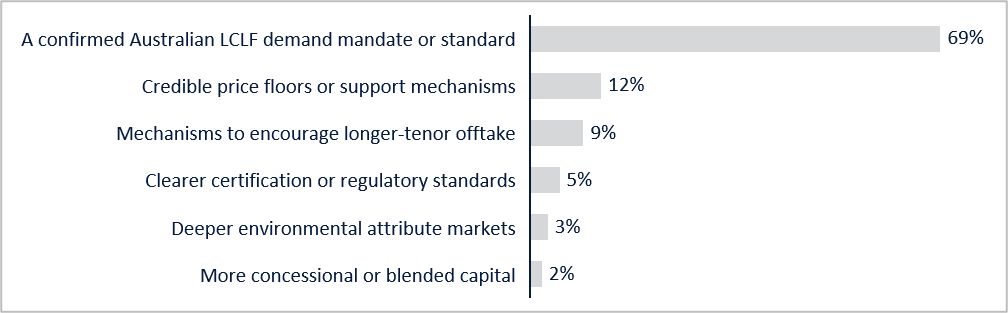
According to survey results, a confirmed Australian LCLF demand mandate or standard is clearly perceived as the single market development that would unlock the most final investment decisions over the next twelve months (Figure 3).
Figure 3: Which single market development would unlock the most FIDs over the next 12 months, share of 65 respondents, Green Fuels Accelerator workshop, 20 August 2026
However, although necessary, even a well-designed demand mechanism is not sufficient as an offtake signal to help projects get to financial close. There is also a need to tackle the price volatility, tenor risks and counterparty risks. This is where a revenue certainty mechanism comes in.
What is a revenue certainty mechanism?
A revenue certainty mechanism (RCM) is a government contract that guarantees a producer a fixed revenue per unit of output. It sits alongside a market instrument that creates the demand, which can be a blending mandate or a carbon intensity standard. The demand mechanism and the revenue certainty mechanism solve different problems. The demand mechanism removes volume risk by obliging fuel suppliers to buy; the revenue certainty mechanism removes price and counterparty risk by fixing what the producer receives per litre.
| Low Carbon Fuel Demand Mechanism | Revenue Certainty Mechanism | |
| Primary problem addressed | Will there be a market for my low-carbon fuel? | Will I earn enough predictable revenue from selling it? |
| Main function | Creates demand / volume certainty | Creates revenue / price certainty |
| Investment signal | “Someone will need to buy this fuel” | “I can finance a project knowing roughly what I’ll earn” |
| Typical mechanism | Mandate, carbon-intensity target, credits | Contract-for-difference, price floor, indexed offtake contract |
| Key risk addressed (subject to design of the RCM) | Demand / market creation | Price volatility, counterparty risk and long-term revenue uncertainty |
| Beneficiaries | Low-carbon fuel producers broadly | Individual projects seeking finance |
In short, it can solve some key issues (subject to the final design of the RCM):
- Price volatility: A demand mechanism can create demand for SAF without guaranteeing the price or margin received by producers. SAF prices are particularly volatile: S&P Global found the standard deviation of European SAF prices since September 2023 was US$444/t, compared with US$95/t for fossil jet fuel, around 3.7x greater volatility. An RCM can provide a price floor or contract-for-difference, protecting projects when market prices fall below an agreed level while allowing government to share in upside when prices rise.
- Tenor: Airlines and fuel suppliers typically do not want to commit their balance sheets for the 10+ years often needed to finance a new SAF plant. Airlines typically hedge fuel only 2-3 years forward, creating a mismatch between the tenor of commercial offtake and the 10-20 year revenue certainty lenders may require. An RCM can address this mismatch by providing a long-term government-backed revenue contract, reducing the extent to which projects need 10+ year commercial offtake commitments to establish revenue certainty; however, the producer still needs to secure buyers for the physical fuel over the project life.
- Counterparty risk: A project relying on a long-term physical offtake agreement remains exposed to the creditworthiness of its airline or fuel-supplier counterparty. An RCM does not eliminate this physical offtaker risk, but it does transfer the credit risk associated with the government-supported revenue payments to a government-backed counterparty, strengthening the bankability of the project’s contracted revenue stream. The UK has explicitly chosen a government-backed counterparty for this reason.
- Policy risk: An RCM can materially mitigate the project’s exposure to future changes in the LCLF demand-side mechanism by providing a contractual revenue floor. If Government reduces the ambition of, or removes, the demand-side mechanism, resulting lower demand and market prices would generally increase the RCM payment, helping preserve the project’s contracted revenue. This effectively transfers a significant portion of the risk of future policy changes from the project to the RCM counterparty, although the extent of protection will depend on the reference-price methodology, any price floor and the legal protections governing the RCM contract.
How does a revenue certainty mechanism work?
Under the revenue certainty mechanism (RCM), low carbon fuel producers sell their fuel directly into the commercial market to airlines, fuel suppliers or other customers (rather than selling the fuel to the government). The RCM supports these transactions by providing a government-backed mechanism which provides a revenue guarantee, with the counterparty topping up the producer’s market revenue when the reference price falls below an agreed strike price, and receiving payments back when market prices exceed the strike price. This provides producers with long-term revenue certainty while preserving normal commercial offtake arrangements and leaving fuel procurement and market allocation to the private sector.
How does it work? A revenue certainty mechanism is a two-way contract for difference. A government-owned counterparty contracts with the producer at a strike price, set at the level needed for the project to be commercially viable. It compares that strike price to a reference price, which is an administered benchmark for the market price of the fuel, not the actual observed market price. The difference between the strike and reference price is not funded by the budget. Instead, it is covered by a variable levy on fossil fuel suppliers, proportional to their share of the fossil fuel market. In this way, government only administers the mechanism and carries no net price exposure.
Figure 4: How the revenue certainty mechanism works alongside an LCLF demand mechanism
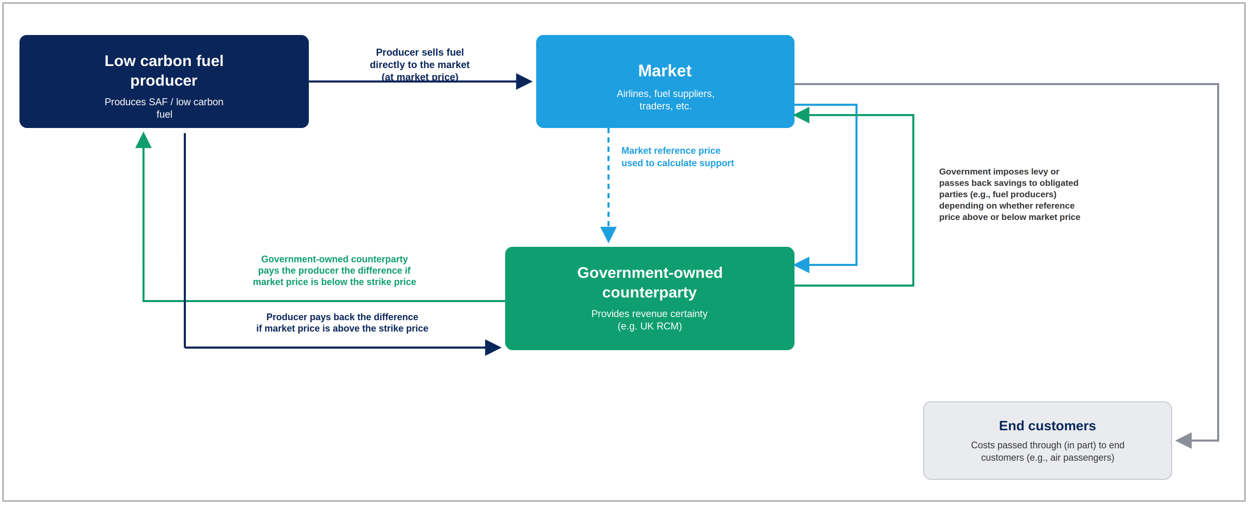
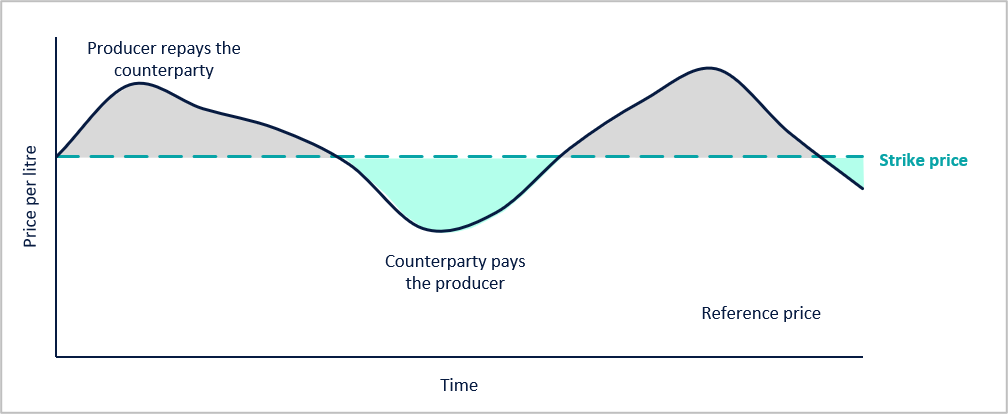
Payments run in both directions: when the reference price is below the strike price the counterparty pays the difference to the producer, and when it sits above, the producer repays the surplus, which is returned to fuel suppliers.
Figure 5: Payments under a two-way contract for difference
Because the offtake obligation sits with a sovereign counterparty rather than a merchant market, the merchant risk perceived by lenders and equity investors is lower, and so is the merchant risk component in the cost of equity and debt. This reduces cost of capital, and the stable contracted revenue supports higher leverage. Together these reduce the required break-even price for low carbon liquid fuels, moving the project from a commodity play to something closer to regulated infrastructure, which is a key precondition for reaching financial close.
International example: The UK Revenue Certainty Mechanism
The United Kingdom confirmed its SAF Revenue Certainty Mechanism in January 2025 and completed its most recent consultation in April 2026. The Low Carbon Contracts Company acts as the counterparty, offering ten-year contracts to eligible producers, funded by a variable levy on fossil aviation fuel suppliers. The first batch is restricted to non-HEFA pathways, using agricultural and municipal waste, so that the support goes to novel technologies rather than delivering a windfall to more mature technology.
The UK Revenue Certainty Mechanism sits on top of a SAF mandate that rises from 2% in 2025 to 10% by 2030 and 22% by 2040, with caps on how much of the obligation HEFA can meet. The UK runs a similar structure in hydrogen, through fifteen-year Low Carbon Hydrogen Agreements with a gas price floor and competitive allocation rounds. The EU Hydrogen Bank does something similar through auctions, where producers bid for a per-kilogram subsidy over a fixed term.
What impact could it have in Australia?
Australia announced in May 2026 that it plans to introduce a low carbon fuels demand mechanism and the recent consultation papers in August 2026 have suggested it could be introduced as soon as 2029. Cyan Ventures has modelled how adding a revenue certainty mechanism to that demand mechanism would impact sustainable aviation fuel (SAF) prices for the HEFA and alcohol to jet (ATJ) pathways, based on the production capacity required to meet the 2030 volumetric SAF target as published in the August 2026 consultation papers.
Production costs fall by 12 to 23%
Subject to its final design (i.e., degree to which it can cover tenor, price volatility and counterparty risk), the revenue certainty mechanism can potentially remove much of the merchant risk premium from both the cost of debt and the cost of equity. That reduction in cost of debt and equity translates to the price a project needs to break even through the weighted average cost of capital (WACC).
Figure 6: Breakeven SAF production cost by offtake counterparty, A$/litre
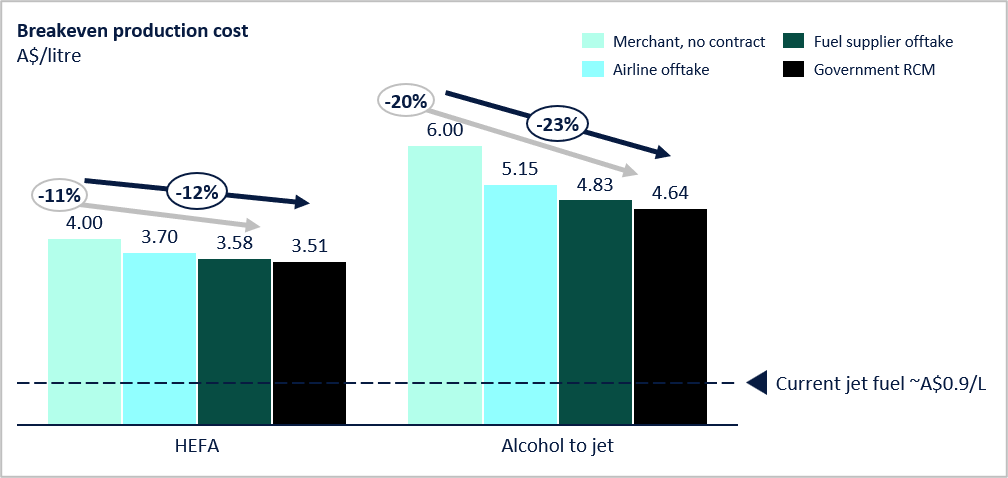
How much capital costs decrease depends on who investors see as the eventual offtaker, and so what credit rating they price. If they treat the government as the offtaker, that moves the HEFA breakeven price from about A$4 to A$3.5 per litre, a reduction of ~12%, and alcohol to jet from about A$6 to A$4.6, a reduction of ~23%. If they look through the contract and instead price the fuel suppliers as the eventual offtaker, the reductions are ~11% and ~20%. This is a design question worth resolving now rather than discovering after the first contract is signed.
Under either reading, a gap between the SAF breakeven price and the jet fuel price remains. That gap represents the green premium that comes with an LCLF demand mechanism. Although the revenue certainty mechanism does not close the gap entirely, it does significantly narrow it. Separate analysis by Cyan Ventures has shown that with low blend rates (e.g,, 5%), the impact on end user costs are minimal (e.g., less than the cost of a cup of coffee for most one-way airline trips in Australia).[3] These end user costs are explored more in the next section.
The revenue certainty mechanism can reduce mandate costs for passengers by ~16%
A cheaper litre of SAF means lower costs associated with the demand mechanism. At a mandated 5% SAF blend the revenue certainty mechanism is estimated to reduce the additional cost per passenger by about 16% on every route.
Figure 7: Additional cost per passenger of a 5% SAF blend, A$
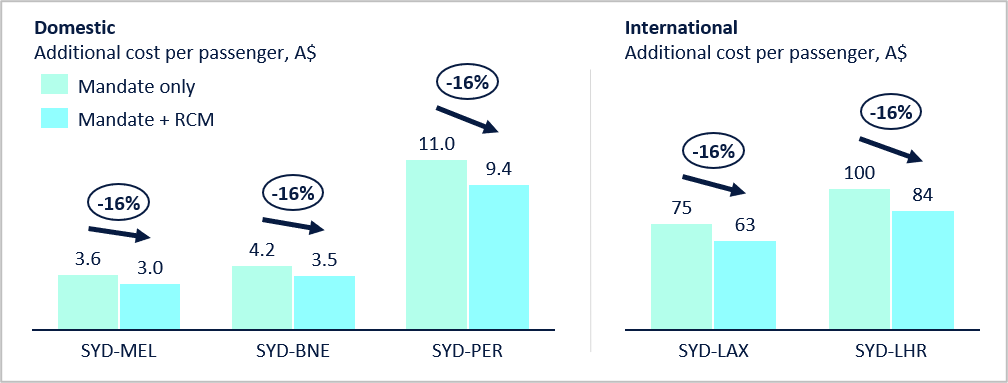
On short domestic flights, the effect is small in absolute terms. Adding a revenue certainty mechanism to a 5% SAF blending mandate moves the ticket price impact from roughly A$3.60 to A$3.00 for a flight from Sydney to Melbourne, both less than the price of a takeaway coffee. Longer flights are where the cost of a mandate becomes more apparent, and where the saving is worth more: Sydney to Los Angeles falls from about A$75 to A$63, which for the consumer means the mandate costs reduce from roughly fourteen coffees to eleven (assuming one coffee costs ~A$5.50). Note that these are simple passenger averages; in practice the cost could be distributed differently between the different fare classes.
The cost reduction a revenue certainty mechanism can achieve matters for more than affordability: an LCLF demand mechanism that raises fares is politically fragile in context of the already rising cost of living, and the mechanism reduces the size of that political problem while not weakening the obligation itself.
The mechanism is fiscally positive
Because the difference payments are assumed to be 100% industry-funded, the only cost that would reach the government budget is administration. Furthermore, a well-designed strike price set based on a competitive process should reflect the forward curve for forecasted LCLF prices into the market and be close to revenue neutral regardless. Against that sit the tax receipts from projects that are assumed to otherwise not have been built. This counter-factual is difficult to ascertain precisely, so the analysis below is based on some simplified scenarios.
Figure 8: Indicative net Treasury benefit of an LCLF demand mechanism and revenue certainty mechanism, low and high case, A$M, NPV 2027 to 2049
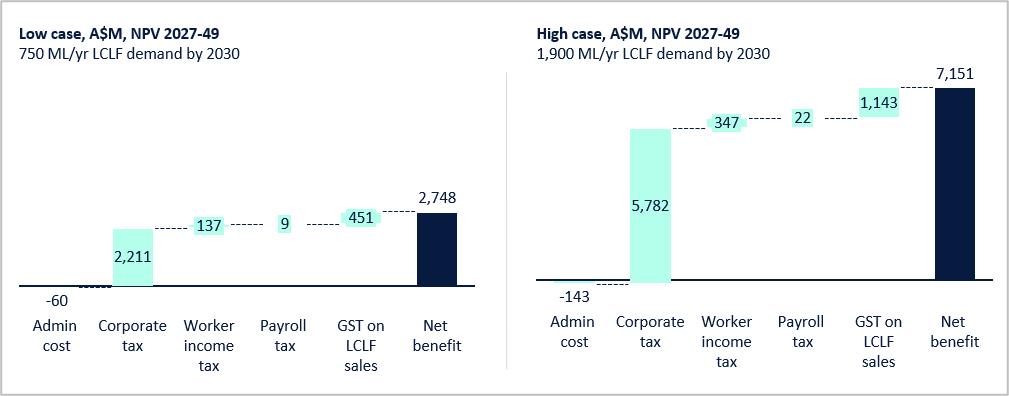
An estimate of the potential fiscal impact was done based on a simplified scenario, using the LCLF demand volumes set out in the Government’s consultation paper of 750 to 1,900 ML per year by 2030. In modelling it was assumed that the demand volume is met by LCLF projects using the HEFA pathway, with a 20-year operating life and a 15-year RCM contract tenor. Administration costs are estimated at about A$60 million[4] in the low case and A$143 million in the high case. Direct tax receipts come to about A$2,808 million and A$7,294 million respectively, dominated in both cases by corporate tax. The net fiscal benefit is therefore roughly A$3 billion at 750 ML per year, rising to about A$7 billion at 1,900 ML per year.
Although the estimated Treasury benefits are attributed to the two mechanisms together, most of the benefit comes from the LCLF demand mechanism rather than the revenue certainty mechanism. However, the revenue certainty mechanism does not need much to justify itself: since the only cost for the revenue certainty mechanism is the administration cost, even if it is responsible for just 10% of the benefit and carries the whole administration cost, it returns about five times its cost.
What are lessons learnt from overseas on how to design and implement it?
The UK is the furthest advanced on this instrument, with legislation passed in August 2026. No contracts have been awarded yet and several design questions remain open, which makes it a useful reference rather than a template. The lessons below draw as much on what is still unresolved as on what has been settled.
- Provide early clarity on scope, eligibility and implementation: Once announced, a revenue certainty mechanism can delay or stall projects rather than accelerate them. Projects need to know how much capacity will be contracted and when contracts will be awarded, so they can plan properly rather than run out of cash while waiting for support. The UK mechanism was first announced in Q3 2023, and contracts may not be allocated until Q4 2028, which is likely to lead to pipeline attrition.[5] Australia should set out the scope, eligibility and timetable as early as it can.
- Bankability depends on the whole contract architecture, not just on a guaranteed strike price: The UK settled on a Guaranteed Strike Price (GSP) rather than a less certain support mechanism, on the basis that it provides the highest level of confidence to investors. But the producer does not receive the strike price in every scenario. The reference price is the higher of the price achieved and a floor, and because the floor caps the difference payment, a producer that sells below it is not compensated for the difference. The lesson for Australia is that a guaranteed strike price on its own does not make a project financeable. What lenders look at is the detail underneath it: how the strike price is set, how the reference and floor prices are defined, and what the offtake contract requires. Therefore, all of these aspects must be designed and tested together.[6]
- Under the UK approach, a government counterparty covers the price, not the buyer (there are options for Australia to extend the design to tackle broader risks): The UK has explicitly decided that the counterparty to the RCM contract should be a government-backed entity, rather than leaving the project exposed to an airline or fuel supplier. Although that is useful, it only covers the difference payment. The producer still has to sell the physical fuel to someone, and still carries that buyer’s credit risk and the need for a long tenor contract to finance against. [7] This is not easy: most airlines have below investment-grade credit ratings, and the fuel suppliers with stronger credit ratings have generally not been signing offtakes, at least in Europe. Australia may want to consider broader design approaches that tackle counterparty risk. Australia could extend the UK RCM by having a government-backed aggregator provide a 10–15 year bankable offtake to the SAF producer, while reselling the physical fuel to airlines and fuel suppliers through shorter 1–2 year contracts. This would transform both the tenor and counterparty risk-giving projects a government-backed long-term revenue contract without requiring airlines to make long-term commitments. Germany’s H2Global provides a direct precedent: a government-backed intermediary signs long-term (10-year) purchase contracts with clean-fuel producers and resells the product through short-term (typically one-year) contracts to end users. Australia could adapt this model for LCLF, using a government-backed aggregator to transform the short tenor and weaker credit of airline offtake into a long-term, bankable government-backed contract for the producer.
- The RCM should complement, not replace, the demand mechanism: The UK is designing the RCM alongside its SAF Mandate, with the two mechanisms deliberately interacting, because they can work against each other in specific ways. [8] A producer with the certainty of a guaranteed price has less reason to strive for a good sales price, so fuel can be sold below market and the scheme costs more than it needs to, which is why the UK is considering a price discovery mechanism. And because UK-supplied fuel earns mandate certificates as well as fuel revenue, with the strike price paid on both, the RCM is directly exposed to the certificate market. It is also crucial they are introduced simultaneously, rather than the delay seen in the UK (with the RCM coming later). The UK’s SAF mandate commenced in January 2025; the revenue certainty mechanism intended to sit alongside it was not legislated until 2026, the strike price and reference price mechanism remain unsettled, and contracts are not expected to be awarded until late 2028. For Australia, this suggests the RCM should be designed as a financing-enabling layer on top of the demand mechanism, rather than as an alternative way of creating demand, and tested for where one weakens the other.
- The reference price has to be one banks will lend against: One of the issues the UK is still working through is how to establish a credible market reference price for SAF, particularly advanced/non-HEFA SAF where there is no deep, transparent global market.[9] However, what makes a reference price good enough is not determined by whether it is transparent and hard for producers to manipulate (although it should be both), it is whether banks will lend against it for a 10 to 15 year contract. What they look at is the gap that can open between the reference price and the price a producer actually achieves (i.e. the basis risk). If lenders believe the achieved price could fall below the floor, the revenue supporting their debt is no longer certain and the mechanism has not done its job. Australia should therefore test candidate reference prices with lenders before settling on one, rather than assessing them only on transparency and gaming.
- Avoid overpaying while retaining sufficient certainty: The UK has recognised a fundamental tension: the strike price needs to be high enough to get projects financed, but government also needs to protect consumers/fuel suppliers from excessive support payments. The UK therefore intends to allocate a limited number of contracts, rather than support all domestic SAF production, with the first round allocated by tendered bid and bilateral negotiation, and competitive price-based allocation under consideration for later rounds. Australia could similarly use competitive allocation/auctions or project-by-project assessment to discover the minimum support required to achieve FID.[10]
- Different pathways and project structures may need different treatment: A single set of eligibility, pricing and delivery terms may not work equally well across SAF technologies, which have different cost bases, technology risk and construction and commissioning periods. The UK excluded HEFA from its first allocation round, but chose not to ringfence support between the remaining technologies, applying portfolio factors during evaluation instead.[11] Australia should consider pathway-specific allocation rounds, evaluation criteria or contract terms where these differences are material.
- The funding side is part of the revenue certainty, not an administrative detail: The UK has chosen a variable levy on aviation fuel suppliers, with further consultation on collection frequency, forecasting, reconciliation, reserves and treatment of surpluses, as well as what happens if a supplier does not pay. The last point is most important: if the counterparty depends on levy receipts to make its difference payments, a supplier that fails to pay puts the producer’s top-up at risk. Putting the funding obligation on industry moves that risk rather than removing it. The UK builds in four protections. The counterparty holds reserves against under-collection. Each supplier posts collateral up front, in cash or as a letter of credit, covering its expected levy bill. If a supplier defaults and its collateral does not cover what it owes, the remaining suppliers share the shortfall. Late or non-payment attracts interest and, ultimately, penalties.[12] Australia should settle the levy rules at the same time as the producer contracts, not afterwards. Suppliers need to know what they will be charged and when, and producers need to know the payments will arrive.
- Keep it targeted and time-limited: The UK views the RCM as a market-creation intervention for the early years, not a permanent subsidy. The legislative notes explicitly say it is intended to stimulate an early SAF market and eventually become unnecessary once investors have confidence in market prices and FOAK technologies have demonstrated commercial scale.[13] There is also a mechanical reason not to let it run indefinitely. The levy recovers whatever the scheme costs, split between suppliers by their share of fossil fuel sales, so the total collected does not fall as fossil use declines. What changes is the charge per litre. The same cost is spread across a shrinking pool of fossil fuel, so unless scheme costs fall at least as quickly, the amount loaded onto each remaining litre climbs. That makes domestic fuel progressively less competitive and sharpens the incentive to buy it elsewhere. Australia could similarly target RCM support at FOAK and early commercial projects, with declining or sunset provisions as the market matures.
Two demand mechanism design features that determine whether the RCM works
The lessons above concern the revenue certainty mechanism itself. Two features of the demand mechanism are also relevant here, because they determine how well the RCM will work.
- Require airlines to buy fuel in Australia to make sure the demand mechanism actually creates offtake: If the obligation applies only to fuel sold here, airlines can arrange their purchasing to avoid it, by carrying extra fuel from their previous stop or fuelling at another hub. That weakens the demand mechanism and reduces the levy collected to fund the RCM. Australia should set a minimum share of fuel that must be purchased here for flights into and out of the country, as the EU does at its departure airports. This risk may be smaller for Australia than elsewhere, given the distances involved and Singapore also being mandated, but it is easier to build the requirement in now than to retrofit it later.
- Ensure the demand mechanism creates a real volume floor by requiring missed volumes to be delivered later: the mandate and the RCM must work hand in hand. Whether the mandated volumes are realised actually appear depends on what happens when an obligated supplier misses its target. If it can pay a fixed buy-out amount instead and pass that cost on to airlines through fuel contracts, buying the fuel becomes the harder option. Australia should require a supplier that pays to still deliver the missed volume in a later year, as the EU does, and set the buy-out above what it would cost to buy compliant fuel. This matters for the RCM because it guarantees producers a price, not a buyer: if the mandated volumes do not appear, producers holding RCM contracts face a smaller market than the trajectory implies.
***
A revenue certainty mechanism can be thought of as a “policy multiplier”, helping increase the potential for impact from the introduction of a low carbon fuel demand mechanism. Designing one alongside Australia’s demand mechanism, and learning from where the UK approach is still unresolved, could increase the pace and likelihood of Australia becoming a green fuels superpower.
References
[1] https://consult.dcceew.gov.au/securing-australias-cleaner-fuels-industry-consultation
[2] S&P Global, Volatile sustainable aviation fuel prices highlight scaling challenges, January 2026
[3] For further details see https://cyanventures.com.au/jet-green-spend-lean-crafting-australias-saf-mandate/
[4] Based on estimated annual UK RCM administration cost (conservative case, undiscounted, retrieved from https://assets.publishing.service.gov.uk/media/685a6765f05cab1603ade6a1/dft-revenue-certainty-mechanism-cost-benefit-analysis.pdf table 3, P31), scaled to capacity
[5] UK Government (2023), Government support for a UK SAF industry, written statement to Parliament, 4 September 2023, committing to introduce a revenue certainty mechanism. UK Department for Transport (2026), Contract Allocation Strategy, para 2.2: applications from Q1 2027, shortlisting from Q4 2027 and contract award from Q4 2028. Para 2.3 requires projects to evidence a robust pathway to completing commissioning no later than the end of Q1 2033
[6] UK Government (2026), Sustainable Aviation Fuel Act 2026, Explanatory Notes, para 16: a guaranteed strike price will be used because it offers the highest level of confidence for investors and builds on the established precedent of Contracts for Difference. Indicative Heads of Terms and Approach to Contract Allocation, paras 1.33 and 1.37: the reference price is the higher of the achieved sales price and a floor, and the floor caps the maximum difference amount payable to the producer.
[7] UK Government (2026), Sustainable Aviation Fuel Act 2026, Explanatory Notes, para 21: the designated counterparty must be a company wholly owned by the Government.
[8] UK Department for Transport (2026), Sustainable Aviation Fuel Revenue Certainty Mechanism: Indicative Heads of Terms and Approach to Contract Allocation, paras 1.27, 1.45, 1.56, 1.67 and 1.92. Para 1.67 gives the specific perverse incentive: a strike price fixed irrespective of carbon savings would cause producers to lose the incentive to produce the SAF that delivers the Mandate most efficiently. The incentive to achieve a good sales price, the associated interest in a price discovery mechanism, and the treatment of Mandate certificate revenue are covered at paras 1.27, 1.45 and 1.56.
[9] UK Department for Transport (2026), Indicative Heads of Terms and Approach to Contract Allocation, paras 1.30 and 1.48, and Contract Allocation Strategy, para 2.18. DfT does not expect a regular, reliable market price for non-HEFA SAF at the time the first contracts are signed, and the reference, floor and strike prices are not yet finalised.
[10] UK Department for Transport (2026), Contract Allocation Strategy, paras 2.11 and 2.54. The first allocation round is capped at 230 kilotonnes of SAF per annum. Note that round one uses a tendered bid process with bilateral negotiation, because purely price-based mechanisms were judged to carry significant risks for an initial round given the limited pipeline; competitive price-based allocation is under consideration for later rounds (para 1.6).
[11] UK Department for Transport (2026), Contract Allocation Strategy, paras 2.21 and 2.25.
[12] UK Department for Transport (2025), Sustainable Aviation Fuel Revenue Certainty Mechanism: Levy Design Consultation. Scheme mechanics at sections 2.6 to 2.43, covering collection frequency, forecasting, reconciliation, reserves and surpluses. The four protections against non-payment at sections 2.32 to 2.33 on counterparty reserves and 3.8 to 3.33 on credit cover, mutualisation across remaining suppliers, interest and penalties.
[13] UK Government (2026), Sustainable Aviation Fuel Act 2026, Explanatory Notes, para 20: the mechanism is intended to be a time-limited measure that will no longer be needed once investors have confidence in the market price and first-of-a-kind technology has proved itself at commercial scale.
Acknowledgements
We gratefully acknowledge the contributions and input of those who reviewed and provided comments on this work. However, responsibility for the analysis, conclusions and recommendations rests solely with Cyan Ventures, and these represent our independent views.
In particular, we would like to thank:
- Ingrid Holmes, Deputy CEO, Green Finance Institute
- Mahesh Roy, Programme Director SAF, Green Finance Institute
- Joe Taylor, Senior Analyst SAF, Green Finance Institute
- Rupert Maloney, Executive Director, CEFC
- James Boyle, Australian Country lead, MPP
- Flyn van Ewijk, Regional Director Asia Pacific, LanzaJet
Sources: Cyan Ventures analysis. Toward an Investible Sustainable Aviation Fuel Sector, Green Finance Institute (2024). Sustainable Aviation Fuel Revenue Certainty Mechanism, UK Department for Transport (2026). SAF RCM Consultation Response, Green Finance Institute (2026). SAF Mandate Final Stage Cost Benefit Analysis, UK Department for Transport. Sustainable Aviation Fuel Act 2026 and Explanatory Notes, UK Government (2026). Indicative Heads of Terms and Approach to Contract Allocation, UK Department for Transport (2026). Contract Allocation Strategy, UK Department for Transport (2026). Levy Design Consultation, UK Department for Transport (2025). Refined Ambitions: Exploring Australia’s path to LCLF, Deloitte and CEFC (2025). IATA Jet Fuel Price Monitor.