

Australia’s competitive position in low-carbon liquid fuels and heavy vehicle electrification
Transport accounts for 21 per cent of Australia’s emissions and is on track to be the single largest source of national emissions by 2030. Australia imports around 80 per cent of its liquid fuel, with one third coming from a single supplier (South Korea), and refining capacity has dropped 70 per cent over the past decade. Transport emissions per capita are more than four times the global average and roughly twice the EU average. The fuel security exposure is severe.
The largest opportunity for Australia is in low-carbon liquid fuels (LCLFs), followed by a smaller opportunity in heavy duty and off-road vehicle EV conversion.
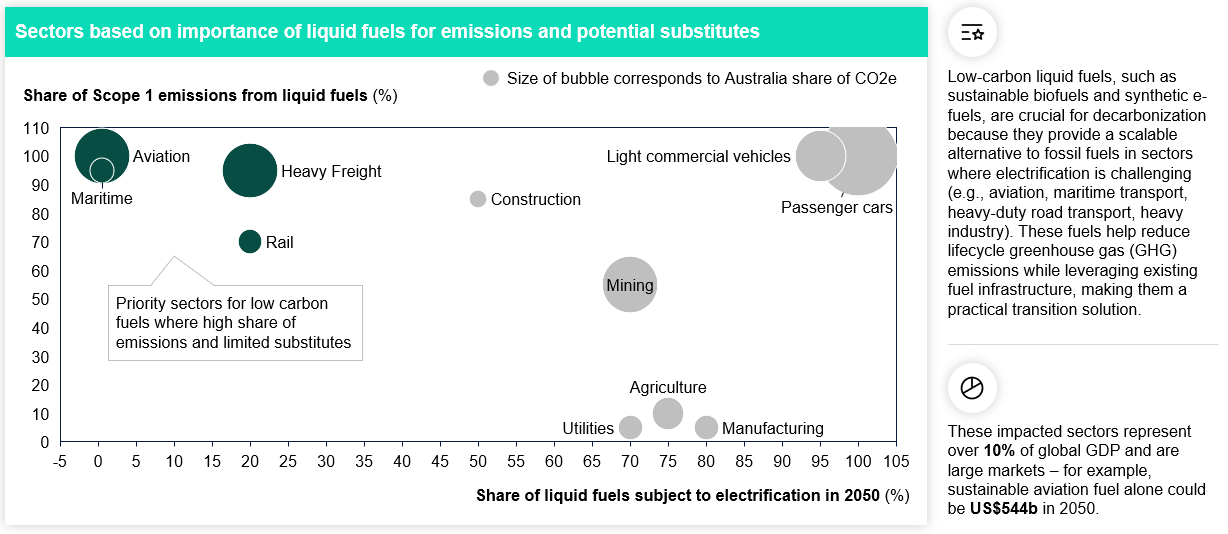
Regarding Low carbon liquid fuels (LCLF), the focus sectors are those which can’t electrify, and they provide a scalable market for Australia.
Exhibit 1. Sectors likely to demand low carbon liquid fuels.[a]
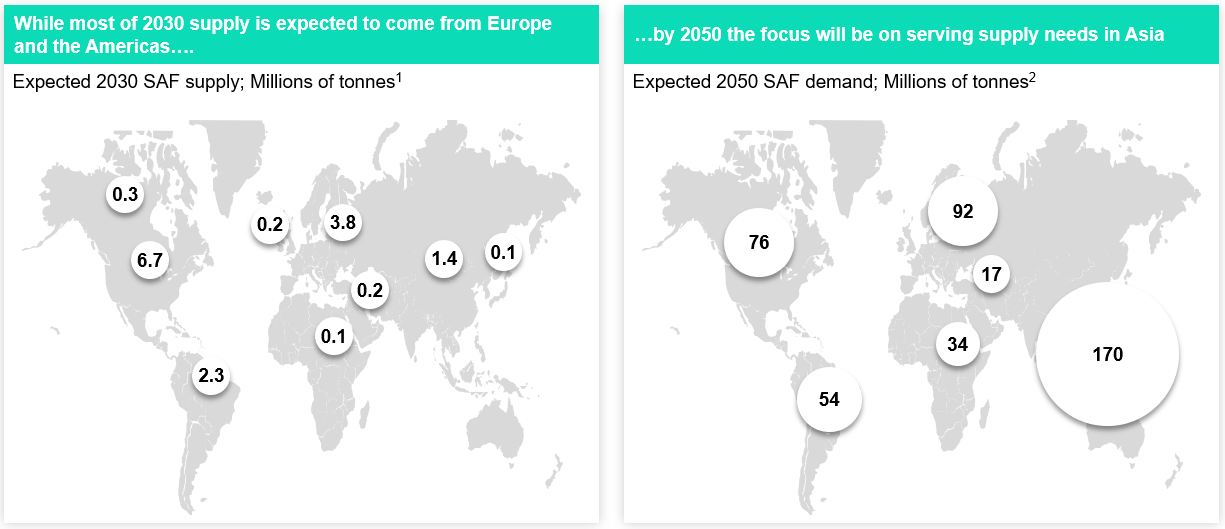
Whilst low carbon liquid fuels will not just serve the aviation industry, to get an idea of size, globally the SAF market is expected to grow to 449 billion litres annually by 2050, with supply gaps potentially emerging in Asia where there has been less focussed development to date than in Europe and the Americas
Exhibit 2. Market for Sustainable aviation fuels alone.[b]
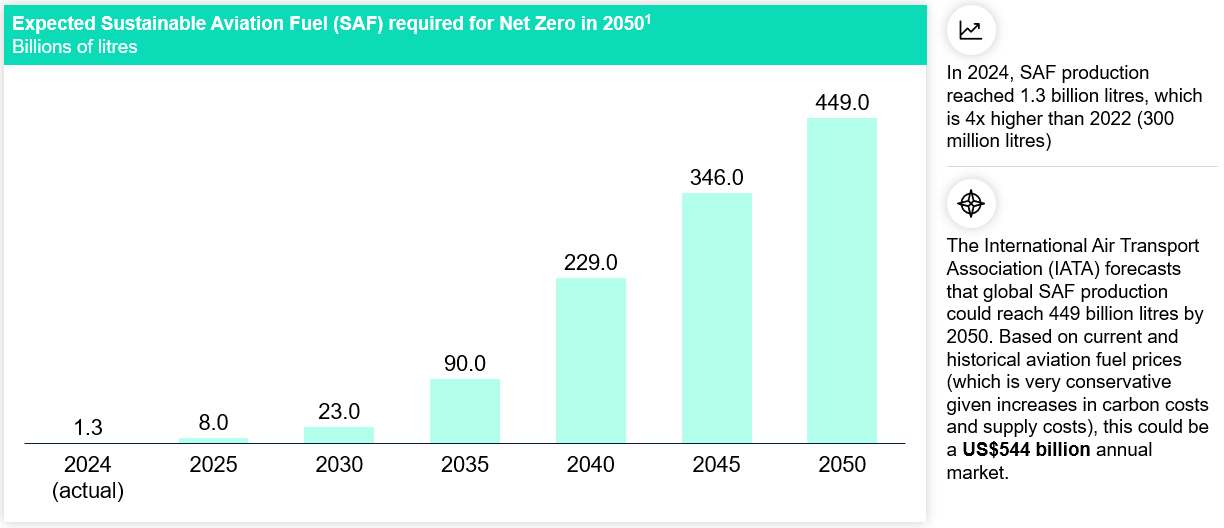
Exhibit 3. Potential low carbon fuel supply mismatch/demand mismatch in Asia.[c]
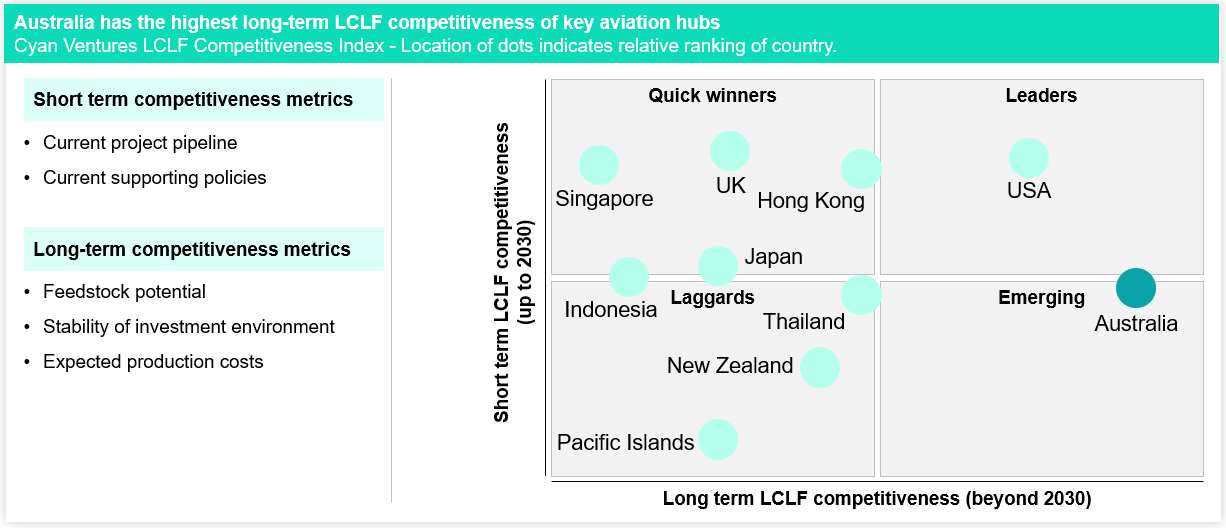
Australia has a strong potential to be a global leader in low carbon fuels due to 4 key drivers assessed on for SAF competitiveness:
- Land: only 2% of Australian land is enough to supply the world’s total aviation fuel needs.
- Logistics: almost all jet fuel is imported with ships returning empty to refineries in (mostly) Asia, so the means of export are already in place.
- Cost of capital: Australia has a generally low weighted cost of capital and a low-risk premium.
- Renewable potential: many of the second generation SAF technologies (e.g. AtJ, FT, Pyrolysis upgrading) are relatively electricity intensive and some require hydrogen. For future E-fuels, renewable energy is around 56% of the total cost. Australia has some of best solar and wind resources globally and if it can decrease the cost of deployment, it can be a global low-cost energy hub.
Exhibit 4. Australia ranks highly on our LCLF competitiveness index.[d]
Beyond LCLF, there is an opportunity for Australia in Transport in the conversion of heavy duty and off-road vehicles into electric. Our competitive drivers here are
- the fact that the customer base is concentrated in Australia (mining and defence buy more heavy-duty vehicles per capita than almost any developed economy),
- the products travel poorly across global supply chains (high mass, low density, configuration-dependent, serviced over decades), and,
- the existing Australian capability base is broader than commonly recognised.
Defence vehicles. Australia already manufactures or assembles three of the world’s most capable, protected military vehicles. The Bushmaster (Thales Bendigo): more than 1,500 produced and exported to nine countries including Ukraine. The Hawkei (also Thales): 1,100 vehicles ordered by the ADF. The Boxer CRV (Rheinmetall MILVEHCOE Ipswich): 211 units under Land 400 Phase 2 plus a planned export pipeline. Under AUKUS and the 2024 National Defence Strategy, sovereign industrial capability for protected vehicles, autonomous platforms and electric drivetrain technology is formally prioritised. The 2024 Defence Industry Development Strategy lists vehicles as one of seven Sovereign Defence Industrial Priorities. Cumulative defence vehicle spend in Australia over the next decade, including replacement and growth, sits in the order of A$15 to 25 billion.
Electric heavy buses and trucks. Australia has retained more bus and truck manufacturing capability than any comparable economy after the 2017 closure of passenger vehicle plants. Volgren (Dandenong), BusTech (Burleigh Heads), Custom Denning (Sydney), SEA Electric, Volvo (Wacol) and Iveco (Brisbane) all produce or assemble heavy electric or hybrid vehicles today. Australia purchases around 4,000 to 5,000 heavy buses a year. State procurement programs (NSW Zero Emissions Bus Strategy, Victoria’s Zero Emission Bus Trial, Queensland’s TransLink fleet transition) commit to fully electric or zero-emission fleets across the next decade. The combined baseload sits at A$1 to 2 billion in annual procurement, supportable by domestic manufacturing.
Mining vehicle customisation & testing. Australia’s iron ore, coal, copper and lithium operations run a haul-truck fleet of roughly 500 to 1,000 ultra-class trucks (190-tonne payload and above), replaced on a 7-to-10-year cycle at US$5 to 7 million per unit. The global ultra-class market sits at around US$15 to 20 billion a year. Australian operators (Rio Tinto, BHP, Fortescue) are the world’s lead users for autonomous fleets and the most active early adopters of battery-electric and hydrogen haul trucks. Fortescue’s Infinity Train and battery-electric haul truck programs, BHP’s Yandi BEV trial, and the Liebherr T 264 BEV co-developed with Fortescue are global firsts being tested in Australian conditions. Whilst the vehicles themselves are being predominantly purchased from overseas OEMs, there is an opportunity in customisation and testing for the Australian environment which is already underway.
Other retrofit, conversion and aftermarket. A fourth, often overlooked layer is the retrofit economy. Janus Electric (Berkeley Vale) converts diesel prime movers to swap-battery electric. SEA Electric repowers cab-chassis trucks. Tomlinson Trucks (Bunbury), MX Mining and a long tail of fabricators produce trailers, mine-site bodies and specialised modifications. Battery 2nd-life applications, EV charger manufacturing and aftermarket parts tie this layer into the broader transport supply chain.
In summary, transport is both a major emissions challenge and a fuel-security vulnerability for Australia, creating a strong case for domestic clean transport industries. The biggest opportunity is in low-carbon liquid fuels, especially for hard-to-electrify sectors such as aviation, shipping and heavy transport, where Australia has advantages in land, renewable energy, logistics and cost of capital, and may be well placed to supply growing demand in Asia. A second, smaller opportunity lies in electrifying heavy-duty and off-road vehicles, where Australia already has meaningful strengths in defence vehicles, buses and trucks, mining vehicle customisation, and retrofit and aftermarket capabilities.
Footnotes:
[a] CEFC and Deloitte draft 2025 LCLF report; Cyan Ventures analysis
[b] IATA (2024), “Net zero 2050: sustainable aviation fuels”
[c] 1. Analysis from SkyNRG Market Outlook 2024; 2. Waypoint 2050 (2021), Fueling Net Zero.
[d] Cyan Ventures analysis